
Ch.6 - Electronic Structure of Atoms
Brown - Chemistry: The Central Science 14th Edition
Brown14th EditionChemistry: The Central ScienceISBN: 9780134414232Non è quello che usi tu?Cambia libro di testo
Capitolo 6, Problema 32

A stellar object is emitting radiation at 3.0 mm. (a) What type of electromagnetic spectrum is this radiation (b) If a detector is capturing 3.0 3 108 photons per second at this wavelength, what is the total energy of the photons detected in 1 day?

Guida verificata passo dopo passo
1
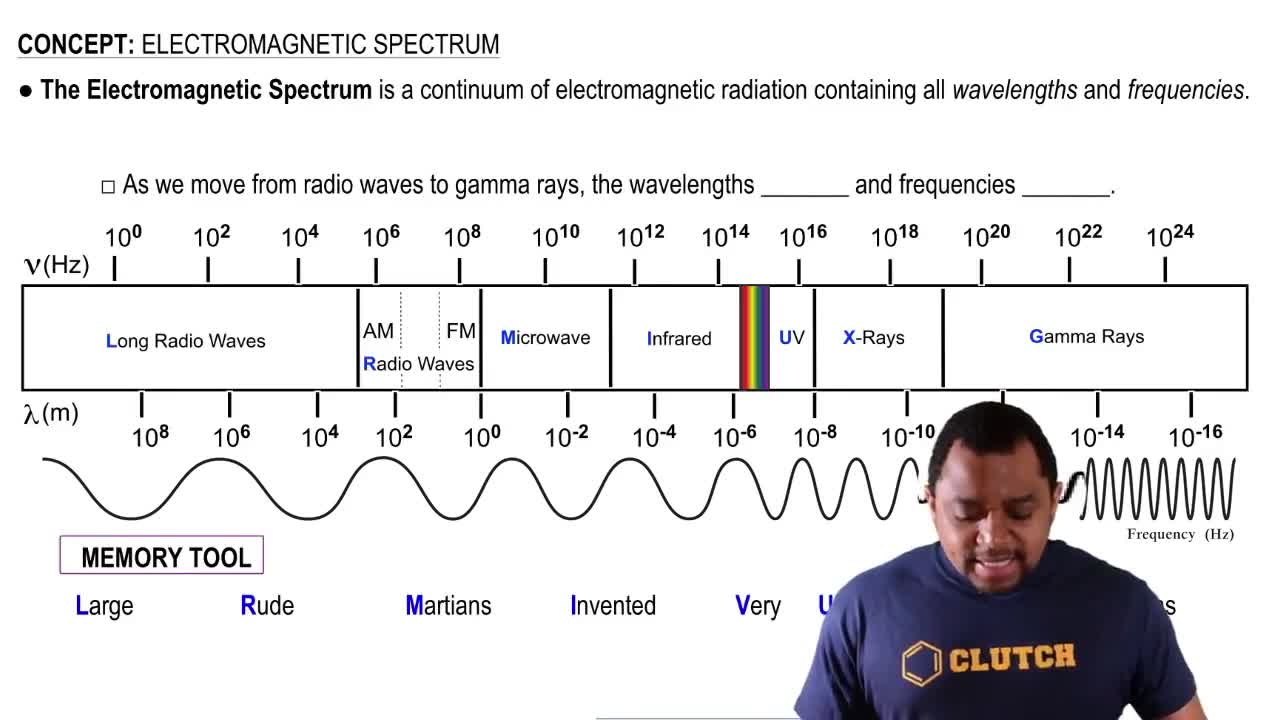
Step 1: Identify the type of electromagnetic radiation. The wavelength of the radiation is given as 3.0 mm. This falls within the range of the microwave region of the electromagnetic spectrum. Therefore, the radiation is a microwave radiation.
Step 2: Calculate the energy of a single photon. The energy of a photon can be calculated using the formula E = h*c/λ, where E is the energy, h is Planck's constant (6.626 x 10^-34 J*s), c is the speed of light (3.0 x 10^8 m/s), and λ is the wavelength. Remember to convert the wavelength from mm to m before using it in the formula.
Step 3: Calculate the energy of all photons detected per second. Multiply the energy of a single photon by the number of photons detected per second (3.0 x 10^8 photons/second).
Step 4: Calculate the total energy of photons detected in 1 day. There are 86400 seconds in a day. Multiply the energy of all photons detected per second by the number of seconds in a day to get the total energy of photons detected in 1 day.
Step 5: The result from step 4 is the total energy of the photons detected in 1 day. Remember to express your answer in the correct units of energy (Joules).

Risposta video verificata per un problema simile:

Questa soluzione video è stata consigliata dai nostri tutor come utile per risolvere questo problema.
Durata del video:
5m

Concetti chiave

Ecco i concetti essenziali che devi comprendere per rispondere correttamente alla domanda.

Electromagnetic Spectrum

The electromagnetic spectrum encompasses all types of electromagnetic radiation, which vary in wavelength and frequency. Radiation at 3.0 mm falls within the microwave region of the spectrum, which is used in various applications, including communication and cooking. Understanding the position of radiation within the spectrum helps in identifying its properties and potential uses.
Video consigliato:
Percorso guidato
02:53
Electromagnetic Spectrum

Photon Energy

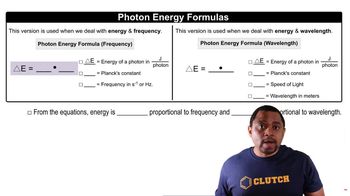
Photons are particles of light, and their energy is directly related to their frequency, as described by the equation E = hν, where E is energy, h is Planck's constant, and ν is frequency. For radiation at 3.0 mm, calculating the energy of individual photons requires converting the wavelength to frequency using the speed of light. This concept is crucial for determining the total energy of multiple photons.
Video consigliato:
Percorso guidato
01:40
Photon Energy Formulas

Energy Calculation Over Time

To find the total energy of photons detected over a specific time period, one must multiply the energy of a single photon by the number of photons detected and the duration of detection. In this case, if 3.0 x 10^8 photons are captured per second, the total energy over one day (86,400 seconds) can be calculated by integrating these values. This concept is essential for understanding how energy accumulates from continuous photon detection.
Video consigliato:
Percorso guidato
01:29
The Gibbs Free Energy Formula Example
Pratica correlata
Domanda del libro di testo

One type of sunburn occurs on exposure to UV light of wavelength in the vicinity of 325 nm. (d) These UV photons can break chemical bonds in your skin to cause sunburn—a form of radiation damage. If the 325-nm radiation provides exactly the energy to break an average chemical bond in the skin, estimate the average energy of these bonds in kJ/mol.

1890
views
Domanda del libro di testo

Molybdenum metal must absorb radiation with an energy higher than 7.22 * 10-19 J ('energy threshold') before it can eject an electron from its surface via the photoelectric effect. (a) What is the frequency threshold for emission of electrons?

863
views
Domanda del libro di testo

A diode laser emits at a wavelength of 987 nm. (a) In what portion of the electromagnetic spectrum is this radiation found? (b) All of its output energy is absorbed in a detector that measures a total energy of 0.52 J over a period of 32 s. How many photons per second are being emitted by the laser?

934
views
Domanda del libro di testo

Molybdenum metal must absorb radiation with an energy higher than 7.22 * 10-19 J ('energy threshold') before it can eject an electron from its surface via the photoelectric effect. (b) What wavelength of radiation will provide a photon of this energy?

656
views
1
comments
Domanda del libro di testo

Molybdenum metal must absorb radiation with an energy higher than 7.22 * 10-19 J ('energy threshold') before it can eject an electron from its surface via the photoelectric effect. (c) If molybdenum is irradiated with light of wavelength of 240 nm, what is the maximum possible velocity of the emitted electrons?

637
views
1
comments
Domanda del libro di testo

The energy from radiation can be used to rupture chemical bonds. A minimum energy of 192 kJ/mol is required to break the bromine–bromine bond in Br2. What is the longest wavelength of radiation that possesses the necessary energy to break the bond? What type of electromagnetic radiation is this?

1758
views
2
rank