Ch.6 - Electronic Structure of Atoms
Brown - Chemistry: The Central Science 14th Edition
Brown14th EditionChemistry: The Central ScienceISBN: 9780134414232Non è quello che usi tu?Cambia libro di testo
Capitolo 6, Problema 73c

(c) What does each box in an orbital diagram represent?

Guida verificata passo dopo passo
1
Understand that an orbital diagram is a visual way to represent the electron configurations of atoms or ions.
Recognize that each box in an orbital diagram represents an orbital, which is a region in an atom where there is a high probability of finding electrons.
Note that each orbital can hold a maximum of two electrons, which must have opposite spins, as indicated by arrows pointing in opposite directions (up and down).
Identify that the arrangement of boxes follows the order of increasing energy levels and sublevels, starting from the lowest energy (1s) to higher energies (2s, 2p, 3s, etc.).
Realize that the filling of these orbitals by electrons in the boxes follows the Pauli Exclusion Principle and Hund's Rule, ensuring that electrons occupy the lowest energy orbitals available and that electrons in the same sublevel occupy different orbitals before pairing up.

Risposta video verificata per un problema simile:

Questa soluzione video è stata consigliata dai nostri tutor come utile per risolvere questo problema.
Durata del video:
5m

Concetti chiave

Ecco i concetti essenziali che devi comprendere per rispondere correttamente alla domanda.

Orbital Diagrams

Orbital diagrams are visual representations of the electron configurations of atoms. Each box in the diagram corresponds to an atomic orbital, which can hold a maximum of two electrons with opposite spins. These diagrams help illustrate how electrons are distributed among the various orbitals in an atom, following the principles of quantum mechanics.
Video consigliato:
Percorso guidato
01:16
Electron Orbital Diagrams

Quantum Mechanics

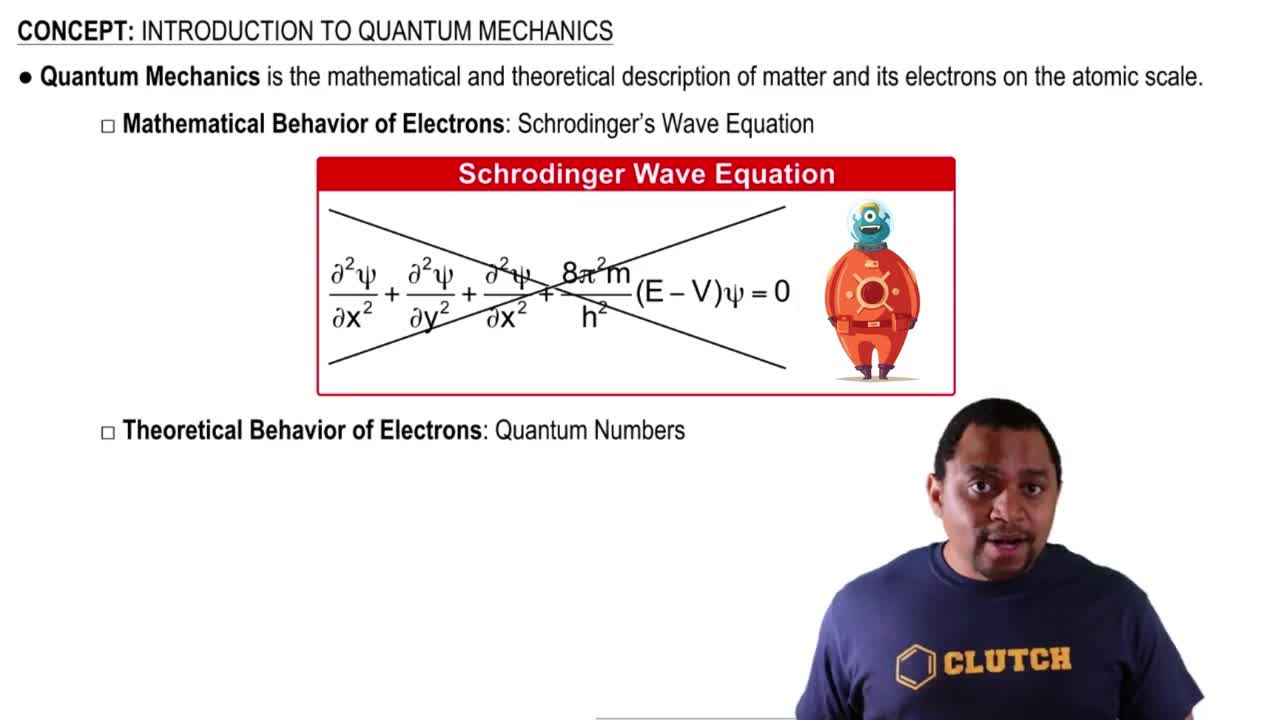
Quantum mechanics is the branch of physics that describes the behavior of matter and energy at the atomic and subatomic levels. It introduces concepts such as wave-particle duality and quantization of energy levels, which are essential for understanding how electrons occupy orbitals and the shapes and orientations of these orbitals in an atom.
Video consigliato:
Percorso guidato
01:
Introduction to Quantum Mechanics

Pauli Exclusion Principle

The Pauli Exclusion Principle states that no two electrons in an atom can have the same set of four quantum numbers. This principle is crucial for understanding the arrangement of electrons in orbitals, as it dictates that each box in an orbital diagram can hold a maximum of two electrons, each with opposite spins, ensuring that the electron configuration adheres to this fundamental rule.
Video consigliato:
Percorso guidato
02:05
Uncertainty Principle Formula