
Ch.6 - Electronic Structure of Atoms
Brown - Chemistry: The Central Science 14th Edition
Brown14th EditionChemistry: The Central ScienceISBN: 9780134414232Non è quello che usi tu?Cambia libro di testo
Capitolo 6, Problema 10b

The accompanying drawing shows a contour plot for a dyz orbital. Consider the quantum numbers that could potentially correspond to this orbital. (b) What is the value of the angular momentum quantum number, l?

Guida verificata passo dopo passo
1
Understand that the dyz orbital is one of the d orbitals, which are characterized by their specific shapes and orientations in space.
Recall that the angular momentum quantum number, denoted as \( l \), determines the shape of the orbital.
Know that for s orbitals, \( l = 0 \); for p orbitals, \( l = 1 \); for d orbitals, \( l = 2 \); and for f orbitals, \( l = 3 \).
Since the dyz orbital is a type of d orbital, the angular momentum quantum number \( l \) for this orbital is 2.
Conclude that the value of \( l \) for a dyz orbital is 2, which is characteristic of all d orbitals.

Risposta video verificata per un problema simile:

Questa soluzione video è stata consigliata dai nostri tutor come utile per risolvere questo problema.
Durata del video:
5m

Concetti chiave

Ecco i concetti essenziali che devi comprendere per rispondere correttamente alla domanda.

Quantum Numbers

Quantum numbers are a set of numerical values that describe the unique quantum state of an electron in an atom. They include the principal quantum number (n), angular momentum quantum number (l), magnetic quantum number (m_l), and spin quantum number (m_s). Each quantum number provides specific information about the electron's energy level, shape, orientation, and spin.
Video consigliato:
Percorso guidato
02:55
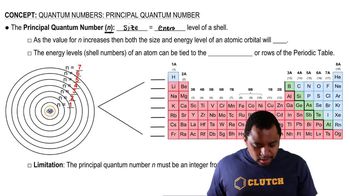
Principal Quantum Number

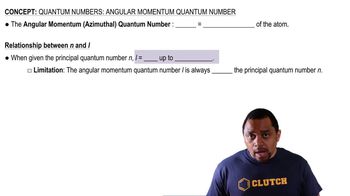
Angular Momentum Quantum Number (l)

The angular momentum quantum number (l) determines the shape of an atomic orbital and can take on integer values from 0 to n-1, where n is the principal quantum number. For example, if n=3, l can be 0, 1, or 2, corresponding to s, p, and d orbitals, respectively. The value of l is crucial for identifying the type of orbital and its associated properties.
Video consigliato:
Percorso guidato
00:40
Angular Momentum Quantum Number

Orbital Shapes and Types

Different types of orbitals (s, p, d, f) have distinct shapes and orientations in space, which are defined by their angular momentum quantum number (l). The dyz orbital, specifically, is a type of d orbital characterized by its two lobes oriented along the y and z axes. Understanding the shapes of orbitals helps in visualizing electron distribution and predicting chemical bonding behavior.
Video consigliato:
Percorso guidato
01:47
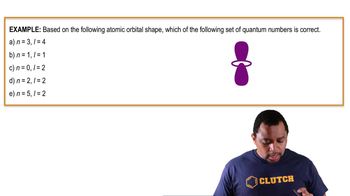
Quantum Numbers and Orbital Shape Example
Pratica correlata
Domanda del libro di testo

Consider a fictitious one-dimensional system with one electron. The wave function for the electron, drawn below, is c1x2 = sin x from x = 0 to x = 2p. (b) At what value or values of x will there be the greatest probability of finding the electron?

526
views
Domanda del libro di testo

The contour representation of one of the orbitals for the n = 3 shell of a hydrogen atom is shown here. (a) What is the quantum number l for this orbital?

448
views
Domanda del libro di testo

Four possible electron configurations for a carbon atom are shown below, but only one schematic represents the correct configuration for a carbon atom in its ground state. Which one is the correct electron configuration?

2654
views
1
rank
1
comments
Domanda del libro di testo

The accompanying drawing shows a contour plot for a dyz orbital. Consider the quantum numbers that could potentially correspond to this orbital. (c) What is the largest possible value of the magnetic quantum number, ml?

516
views
Domanda del libro di testo

The accompanying drawing shows a contour plot for a dyz orbital. Consider the quantum numbers that could potentially correspond to this orbital. (d) The probability density goes to zero along which of the following planes: xy, xz, or yz?

737
views
Domanda del libro di testo

The contour representation of one of the orbitals for the n = 3 shell of a hydrogen atom is shown here. (c) In which of the following ways would you modify this sketch if the value of the magnetic quantum number, ml, were to change? (i) It would be drawn larger, (ii) the number of lobes would change, (iii) the lobes of the orbital would point in a different direction, (iv) there would be no change in the sketch.

209
views