
Ch.6 - Electronic Structure of Atoms
Brown - Chemistry: The Central Science 14th Edition
Brown14th EditionChemistry: The Central ScienceISBN: 9780134414232Non è quello che usi tu?Cambia libro di testo
Capitolo 6, Problema 91a

The series of emission lines of the hydrogen atom for which nf = 3 is called the Paschen series. (a) Determine the region of the electromagnetic spectrum in which the lines of the Paschen series are observed.

Guida verificata passo dopo passo
1
Identify the initial and final energy levels for the Paschen series. The final energy level \( n_f \) is 3, and the initial energy level \( n_i \) is greater than 3.
Use the Rydberg formula for hydrogen to calculate the wavelength of the emitted light: \( \frac{1}{\lambda} = R_H \left( \frac{1}{n_f^2} - \frac{1}{n_i^2} \right) \), where \( R_H \) is the Rydberg constant.
Calculate the wavelengths for transitions from higher energy levels (e.g., \( n_i = 4, 5, 6, \ldots \)) to \( n_f = 3 \).
Determine the range of wavelengths obtained from these calculations.
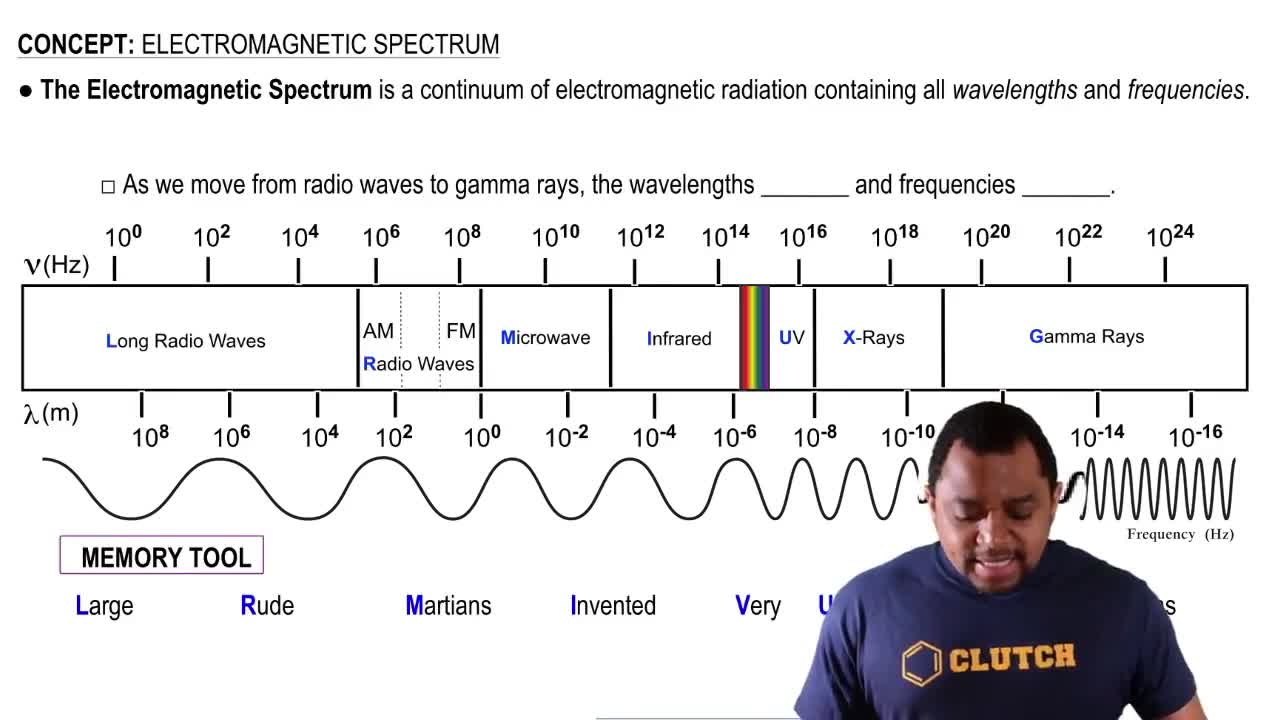
Identify the region of the electromagnetic spectrum corresponding to these wavelengths, which is the infrared region.

Risposta video verificata per un problema simile:

Questa soluzione video è stata consigliata dai nostri tutor come utile per risolvere questo problema.
Durata del video:
54s

Concetti chiave

Ecco i concetti essenziali che devi comprendere per rispondere correttamente alla domanda.

Electromagnetic Spectrum

The electromagnetic spectrum encompasses all types of electromagnetic radiation, arranged by wavelength or frequency. It includes gamma rays, X-rays, ultraviolet light, visible light, infrared radiation, microwaves, and radio waves. Each type of radiation has distinct properties and applications, with the visible spectrum being just a small part of the entire range.
Video consigliato:
Percorso guidato
02:53
Electromagnetic Spectrum

Hydrogen Emission Spectrum

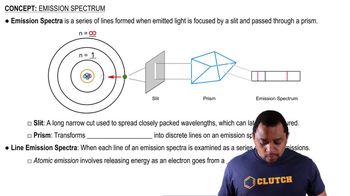
The hydrogen emission spectrum is the spectrum of light emitted by hydrogen atoms when they transition from higher energy levels to lower ones. Each transition corresponds to a specific wavelength of light, resulting in distinct emission lines. The Paschen series specifically refers to transitions where electrons fall to the n=3 energy level, producing infrared radiation.
Video consigliato:
Percorso guidato
01:51
Emission Spectra

Paschen Series

The Paschen series is a set of spectral lines in the hydrogen emission spectrum that occurs when electrons transition to the third energy level (n=3) from higher levels (n=4, 5, 6, etc.). These transitions emit photons in the infrared region of the electromagnetic spectrum, which is not visible to the human eye but can be detected with appropriate instruments.
Video consigliato:
Percorso guidato
02:02
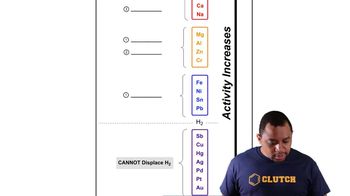
Activity Series Chart
Pratica correlata
Domanda del libro di testo

Determine whether each of the following sets of quantum numbers for the hydrogen atom are valid. If a set is not valid, indicate which of the quantum numbers has a value that is not valid: (a) n = 3, l = 3, ml = 2, ms = +1/2 (b) n = 4, l = 3, ml = -3, ms = +1/2 (c) n = 3, l = 1, ml = 2, ms = +1/2 (d) n = 5, l = 0, ml = 0, ms = 0 (e) n = 2, l = 1, ml = 1, ms = -1/2

1456
views
Domanda del libro di testo

The series of emission lines of the hydrogen atom for which nf = 3 is called the Paschen series. (b) Calculate the wavelengths of the first three lines in the Paschen series—those for which ni = 4, 5, and 6.

710
views
Domanda del libro di testo

The human retina has three types of receptor cones, each sensitive to a different range of wavelengths of visible light, as shown in this figure (the colors are merely to differentiate the three curves from one another; they do not indicate the actual colors represented by each curve):

(c) Explain why the sky appears blue even though all wavelengths of solar light are scattered by the atmosphere.

548
views
Domanda del libro di testo

Consider a transition in which the electron of a hydrogen atom is excited from n = 1 to n = ∞. (d) How are the results of parts (b) and (c) related to the plot shown in Exercise 6.88?

558
views
Domanda del libro di testo

Consider a transition in which the electron of a hydrogen atom is excited from n = 1 to n = ∞.  (c) What will occur if light with a shorter wavelength than that in part (b) is used to excite the hydrogen atom?

2
views