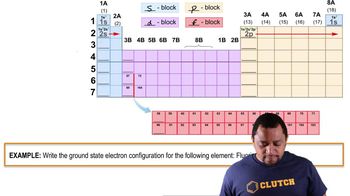
For each element, indicate the number of valence electrons, core electrons, and unpaired electrons in the ground state: (c) fluorine.
Ch.6 - Electronic Structure of Atoms
Brown14th EditionChemistry: The Central ScienceISBN: 9780134414232Non è quello che usi tu?Cambia libro di testo
Capitolo 6, Problema 76f
Write the condensed electron configurations for the following atoms and indicate how many unpaired electrons each has: (f) Lu.
Guida verificata passo dopo passo1
Identify the atomic number of Lutetium (Lu) from the periodic table, which is 71.
Write the electron configuration for Lu. Start from the nearest noble gas with a lower atomic number, which is Xenon (Xe), and then add the remaining electrons to the orbitals in the order of increasing energy levels.
The electron configuration of Lu starting from Xe is: [Xe] 6s^2 4f^14 5d^1.
Condense the electron configuration by incorporating the noble gas notation and the filled subshells: [Xe] 4f^14 5d^1 6s^2.
Determine the number of unpaired electrons by examining the electron configuration. In Lu, the 5d orbital has 1 electron, which is unpaired, resulting in one unpaired electron.

Risposta video verificata per un problema simile:
Questa soluzione video è stata consigliata dai nostri tutor come utile per risolvere questo problema.
Durata del video:
4mConcetti chiave
Ecco i concetti essenziali che devi comprendere per rispondere correttamente alla domanda.
Electron Configuration
Electron configuration describes the distribution of electrons in an atom's orbitals. It is represented using a notation that indicates the energy levels and sublevels occupied by electrons, following the Aufbau principle, Pauli exclusion principle, and Hund's rule. For example, the electron configuration of Lutetium (Lu) is [Xe] 6s² 4f¹⁴, showing how electrons fill the available orbitals.
Video consigliato:
Percorso guidato
Electron Configuration Example
Unpaired Electrons
Unpaired electrons are those that occupy an orbital alone rather than in pairs. The presence of unpaired electrons is crucial for determining an atom's magnetic properties and reactivity. In the case of Lutetium, it has no unpaired electrons in its ground state configuration, as all its electrons are paired in the 4f and 6s orbitals.
Video consigliato:
Percorso guidato
Electron Geometry
Hund's Rule
Hund's Rule states that electrons will fill degenerate orbitals (orbitals of the same energy) singly before pairing up. This principle helps minimize electron-electron repulsion and stabilizes the atom. Understanding this rule is essential for predicting the number of unpaired electrons in an atom, which is particularly relevant when analyzing transition metals and lanthanides like Lutetium.
Video consigliato:
Percorso guidato
Solubility Rules
Pratica correlata
Domanda del libro di testo
563
views
1
comments
Domanda del libro di testo
Identify the specific element that corresponds to each of the following electron configurations and indicate the number of unpaired electrons for each: (d) 3Kr45s24d105p4.
387
views
Domanda del libro di testo
Identify the specific element that corresponds to each of the following electron configurations and indicate the number of unpaired electrons for each: (a) 1s22s2 (b) 1s22s22p4
574
views
Domanda del libro di testo
Write the condensed electron configurations for the following atoms and indicate how many unpaired electrons each has: (a) Mg (b) Ge (c) Br (d) V (e) Y.
927
views
Domanda del libro di testo
Identify the specific element that corresponds to each of the following electron configurations and indicate the number of unpaired electrons for each: (c) 3Ar44s13d5
664
views