Ch.7 - Periodic Properties of the Elements
Brown - Chemistry: The Central Science 14th Edition
Brown14th EditionChemistry: The Central ScienceISBN: 9780134414232Non è quello che usi tu?Cambia libro di testo
Capitolo 7, Problema 71

(a) As described in Section 7.7, the alkali metals react with hydrogen to form hydrides and react with halogens to form halides. Compare the roles of hydrogen and halogens in these reactions. Write balanced equations for the reaction of fluorine with calcium and for the reaction of hydrogen with calcium. (b) What is the oxidation number and electron configuration of calcium in each product?

Guida verificata passo dopo passo
1
Identify the products in the reaction involving calcium. If the reaction or products are not specified, consider common compounds of calcium such as calcium oxide (CaO), calcium chloride (CaCl2), and calcium carbonate (CaCO3).
Determine the oxidation number of calcium in each product. Remember that the oxidation number of calcium is typically +2 in its compounds, as it tends to lose two electrons to achieve a stable electron configuration.
Write the electron configuration for calcium in its elemental state. The atomic number of calcium is 20, so its electron configuration is \$1s^2 2s^2 2p^6 3s^2 3p^6 4s^2$.
Understand that upon ionization when forming compounds, calcium loses the two electrons in its outermost 4s orbital. This results in the electron configuration for Ca^2+ as \$1s^2 2s^2 2p^6 3s^2 3p^6$.
Apply this understanding to each product identified in step 1, confirming that the electron configuration of calcium in its ionic form (Ca^2+) remains consistent across different compounds.

Risposta video verificata per un problema simile:

Questa soluzione video è stata consigliata dai nostri tutor come utile per risolvere questo problema.
Durata del video:
10m

Concetti chiave

Ecco i concetti essenziali che devi comprendere per rispondere correttamente alla domanda.

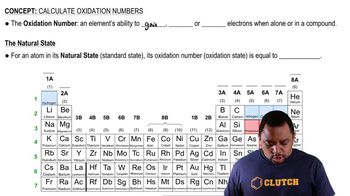
Oxidation Number

The oxidation number, or oxidation state, is a value that represents the total number of electrons an atom either gains or loses when it forms a compound. It helps in understanding the electron transfer in redox reactions. For calcium, which is an alkaline earth metal, the oxidation number is typically +2 in compounds, indicating it loses two electrons.
Video consigliato:
Percorso guidato
02:42
Oxidation Numbers

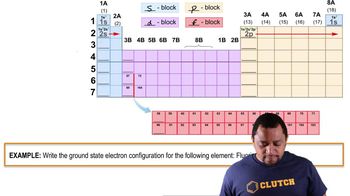
Electron Configuration

Electron configuration describes the distribution of electrons in an atom's orbitals. For calcium, the electron configuration is 1s² 2s² 2p⁶ 3s², indicating that it has two electrons in its outermost shell. This configuration is crucial for determining how calcium interacts chemically, particularly in forming compounds.
Video consigliato:
Percorso guidato
01:33
Electron Configuration Example

Chemical Products

In a chemical reaction, products are the substances formed as a result of the reaction. The oxidation state and electron configuration of an element can change depending on the products formed. Understanding the nature of these products is essential for determining the final oxidation state and electron configuration of calcium in the context of the reaction.
Video consigliato:
Percorso guidato
01:30
Production of Hydrogen Example