Ch.7 - Periodic Properties of the Elements
Brown - Chemistry: The Central Science 14th Edition
Brown14th EditionChemistry: The Central ScienceISBN: 9780134414232Non è quello che usi tu?Cambia libro di testo
Capitolo 7, Problema 27b

Identify each statement as true or false: (b) Li+ is smaller than Li.

Guida verificata passo dopo passo
1
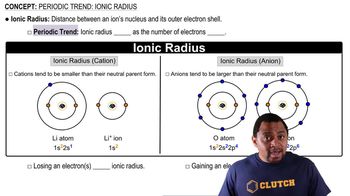
Consider the electronic configuration of a neutral lithium atom (Li), which is 1s^2 2s^1.
When lithium loses an electron to form Li^+, it loses the 2s electron, resulting in the electronic configuration 1s^2.
Li^+ has fewer electrons than Li, leading to a decrease in electron-electron repulsion and a smaller electron cloud.
The loss of an electron also means that the effective nuclear charge experienced by the remaining electrons is greater, pulling them closer to the nucleus.
Therefore, Li^+ is smaller in size compared to the neutral Li atom.

Risposta video verificata per un problema simile:

Questa soluzione video è stata consigliata dai nostri tutor come utile per risolvere questo problema.
Durata del video:
2m

Concetti chiave

Ecco i concetti essenziali che devi comprendere per rispondere correttamente alla domanda.

Ionic vs. Atomic Radius

The ionic radius refers to the size of an ion, while the atomic radius refers to the size of a neutral atom. When an atom loses an electron to form a cation, like Li<sup>+</sup>, it typically becomes smaller due to the reduced electron-electron repulsion and the increased effective nuclear charge acting on the remaining electrons.
Video consigliato:

Cation Formation

Cations are positively charged ions formed when an atom loses one or more electrons. In the case of lithium (Li), when it loses an electron to become Li<sup>+</sup>, the loss of the outermost electron leads to a decrease in size, as the remaining electrons are drawn closer to the nucleus due to the higher positive charge.
Video consigliato:
Percorso guidato
02:34
Enthalpy of Formation

Periodic Trends

Periodic trends refer to predictable patterns in the properties of elements across the periodic table. One such trend is that cations are generally smaller than their parent atoms, which is observed in the case of Li<sup>+</sup> being smaller than neutral Li, aligning with the trend that cation size decreases across a period.
Video consigliato:
Percorso guidato
00:38
Periodic Trends