Ch.7 - Periodic Properties of the Elements
Brown - Chemistry: The Central Science 14th Edition
Brown14th EditionChemistry: The Central ScienceISBN: 9780134414232Non è quello che usi tu?Cambia libro di testo
Capitolo 7, Problema 27c

Identify each statement as true or false: (c) Cl- is bigger than I-.

Guida verificata passo dopo passo
1
To determine the relative sizes of Cl- and I-, we need to consider the concept of ionic radii. Ionic radius is the measure of an atom's ion in a crystal lattice.
Recall that as you move down a group in the periodic table, the ionic radius increases. This is because additional electron shells are added, increasing the distance between the nucleus and the outermost electrons.
Chlorine (Cl) is in the third period, while iodine (I) is in the fifth period of the periodic table. Therefore, I- has more electron shells than Cl-.
Since I- has more electron shells, it is larger in size compared to Cl-. The increased number of electron shells outweighs the effect of increased nuclear charge.
Based on this understanding, the statement 'Cl- is bigger than I-' is false, as I- is actually larger than Cl-.

Risposta video verificata per un problema simile:

Questa soluzione video è stata consigliata dai nostri tutor come utile per risolvere questo problema.
Durata del video:
2m

Concetti chiave

Ecco i concetti essenziali che devi comprendere per rispondere correttamente alla domanda.

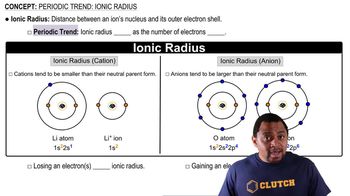
Ionic Radius

The ionic radius refers to the size of an ion in a crystal lattice. Cations (positively charged ions) are typically smaller than their neutral atoms due to the loss of electrons, while anions (negatively charged ions) are larger due to the gain of electrons. Understanding ionic radius is crucial for comparing the sizes of different ions.
Video consigliato:

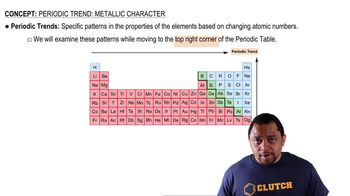
Periodic Trends

Periodic trends are patterns observed in the properties of elements across the periodic table. For instance, ionic size generally increases down a group due to the addition of electron shells, while it decreases across a period due to increased nuclear charge. Recognizing these trends helps in predicting the relative sizes of ions.
Video consigliato:
Percorso guidato
00:38
Periodic Trends

Chloride vs. Iodide Ions

Chloride (Cl<sup>-</sup>) and iodide (I<sup>-</sup>) are both anions, but they differ in size. Iodide is larger than chloride because iodine is located further down in the periodic table, resulting in more electron shells. This difference in size is essential for understanding the statement in the question.
Video consigliato: