
Ch.7 - Periodic Properties of the Elements
Brown - Chemistry: The Central Science 14th Edition
Brown14th EditionChemistry: The Central ScienceISBN: 9780134414232Non è quello che usi tu?Cambia libro di testo
Capitolo 7, Problema 93

In the chemical process called electron transfer, an electron is transferred from one atom or molecule to another. (We will talk about electron transfer extensively in Chapter 20.) A simple electron transfer reaction is A(g) + A(g) → A+(g) + A-(g) For a representative nonmetal such as chlorine, is this process exothermic?

Guida verificata passo dopo passo
1
Identify the process: The reaction involves the transfer of an electron from one chlorine atom to another, forming a positive ion \( \text{Cl}^+ \) and a negative ion \( \text{Cl}^- \).
Consider the energy changes: Ionization energy is required to remove an electron from \( \text{Cl} \) to form \( \text{Cl}^+ \), and electron affinity is released when an electron is added to \( \text{Cl} \) to form \( \text{Cl}^- \).
Compare ionization energy and electron affinity: For chlorine, the ionization energy is typically higher than the electron affinity, meaning more energy is required to remove an electron than is released when an electron is gained.
Determine the overall energy change: Since the ionization energy is greater than the electron affinity, the process requires more energy input than is released, making it endothermic.
Conclude the nature of the process: Therefore, the electron transfer process for chlorine is endothermic, not exothermic.

Risposta video verificata per un problema simile:

Questa soluzione video è stata consigliata dai nostri tutor come utile per risolvere questo problema.
Durata del video:
3m

Concetti chiave

Ecco i concetti essenziali che devi comprendere per rispondere correttamente alla domanda.

Electron Transfer

Electron transfer refers to the movement of electrons from one atom or molecule to another, which is fundamental in redox reactions. In the given reaction, one atom loses an electron (oxidation) while another gains it (reduction), resulting in charged species. Understanding this process is crucial for analyzing the energy changes associated with the reaction.
Video consigliato:
Percorso guidato
04:44
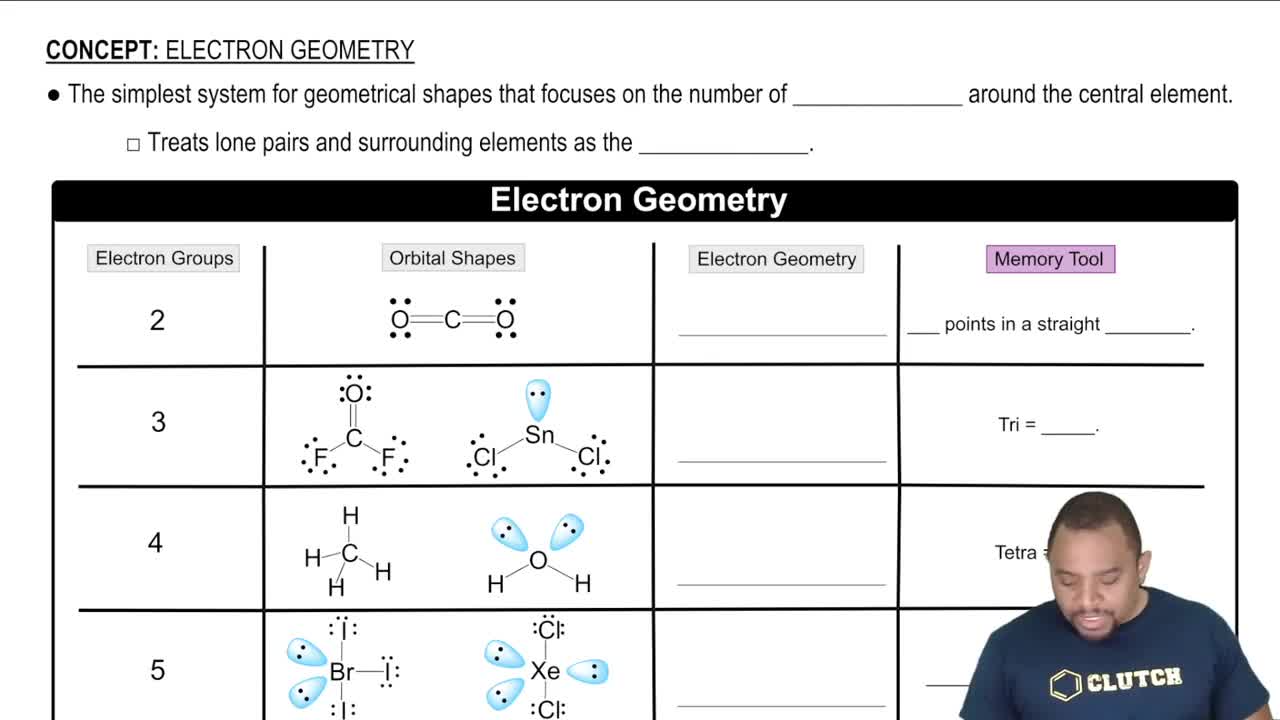
Electron Geometry

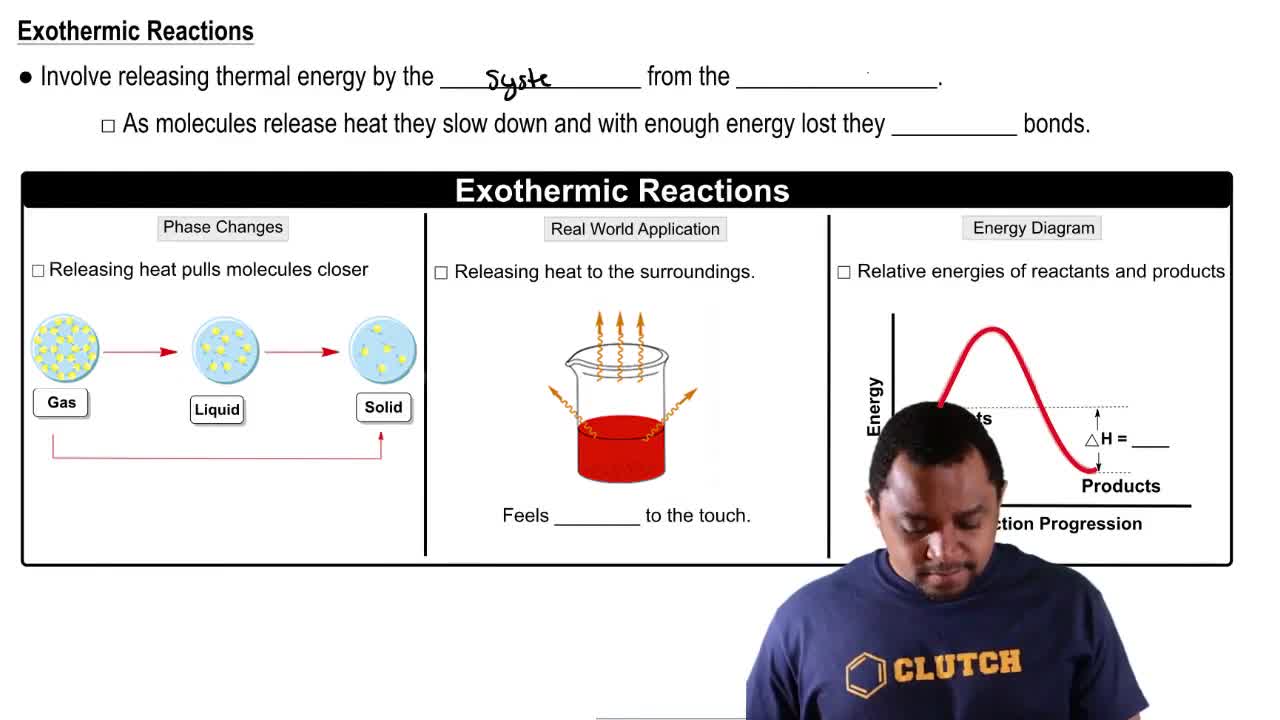
Exothermic Reactions

An exothermic reaction is a chemical reaction that releases energy, usually in the form of heat, to its surroundings. This occurs when the total energy of the products is lower than that of the reactants, indicating that energy is released during the formation of products. Determining whether the electron transfer process is exothermic involves evaluating the energy changes associated with the formation of ions.
Video consigliato:
Percorso guidato
02:38
Endothermic & Exothermic Reactions

Chlorine as a Nonmetal

Chlorine is a representative nonmetal that readily accepts electrons to form negatively charged ions (Cl⁻). Its high electronegativity makes it a strong oxidizing agent, which influences the energy dynamics of electron transfer reactions. Understanding chlorine's behavior in electron transfer is essential for predicting whether the process is exothermic or endothermic.
Video consigliato:
Percorso guidato
01:12
Nonmetal Properties