

Ch.7 - Periodic Properties of the Elements
Brown - Chemistry: The Central Science 14th Edition
Brown14th EditionChemistry: The Central ScienceISBN: 9780134414232Non è quello che usi tu?Cambia libro di testo
Capitolo 7, Problema 85b

The As ¬ As bond length in elemental arsenic is 2.48 Å. The Cl ¬ Cl bond length in Cl2 is 1.99 Å. (b) What bond length is predicted for AsCl3, using the atomic radii in Figure 7.7?

Guida verificata passo dopo passo
1
Identify the atomic radii of arsenic (As) and chlorine (Cl) from Figure 7.7.
Recall that the bond length in a molecule is approximately the sum of the atomic radii of the two bonded atoms.
Add the atomic radius of arsenic to the atomic radius of chlorine to estimate the As-Cl bond length.
Express the bond length in appropriate units, typically in Ångströms (Å).
Verify the calculated bond length with known data or literature values, if available, to ensure accuracy.

Risposta video verificata per un problema simile:

Questa soluzione video è stata consigliata dai nostri tutor come utile per risolvere questo problema.
Durata del video:
1m

Concetti chiave

Ecco i concetti essenziali che devi comprendere per rispondere correttamente alla domanda.

Bond Length

Bond length is the distance between the nuclei of two bonded atoms. It is influenced by the size of the atoms involved and the type of bond (single, double, etc.). Understanding bond lengths helps predict molecular geometry and reactivity, as shorter bonds typically indicate stronger interactions.
Video consigliato:
Percorso guidato
00:36
Average Bond Order

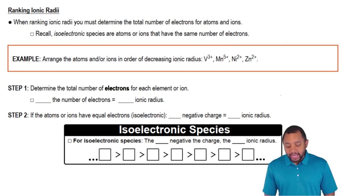
Atomic Radii

Atomic radii refer to the size of an atom, typically measured from the nucleus to the outermost electron shell. These values vary across the periodic table and are crucial for estimating bond lengths in compounds. The effective atomic radius can change depending on the bonding environment and the type of atoms involved.
Video consigliato:
Percorso guidato
03:56
Ranking Ionic Radii

Molecular Geometry

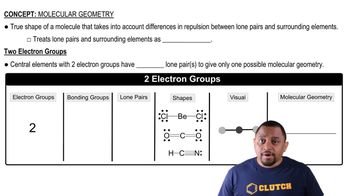
Molecular geometry describes the three-dimensional arrangement of atoms within a molecule. It is determined by the number of bonds and lone pairs around the central atom, influencing properties like polarity and reactivity. Understanding molecular geometry is essential for predicting bond lengths and angles in compounds like AsCl3.
Video consigliato:
Percorso guidato
01:33
Molecular Geometry with Two Electron Groups