Ch.7 - Periodic Properties of the Elements
Brown - Chemistry: The Central Science 14th Edition
Brown14th EditionChemistry: The Central ScienceISBN: 9780134414232Non è quello che usi tu?Cambia libro di testo
Capitolo 7, Problema 87a

Elements in group 7A in the periodic table are called the halogens; elements in group 6A are called the chalcogens. (a) What is the most common oxidation state of the chalcogens compared to the halogens?

Guida verificata passo dopo passo
1
Identify the elements in group 6A (chalcogens) and group 7A (halogens) of the periodic table.
Recall that the most common oxidation state for an element is often related to the number of electrons needed to achieve a full outer shell.
For chalcogens (group 6A), note that they have six valence electrons and need two more electrons to achieve a full octet, leading to a common oxidation state of -2.
For halogens (group 7A), note that they have seven valence electrons and need one more electron to achieve a full octet, leading to a common oxidation state of -1.
Compare the most common oxidation states: chalcogens typically have an oxidation state of -2, while halogens typically have an oxidation state of -1.

Risposta video verificata per un problema simile:

Questa soluzione video è stata consigliata dai nostri tutor come utile per risolvere questo problema.
Durata del video:
2m

Concetti chiave

Ecco i concetti essenziali che devi comprendere per rispondere correttamente alla domanda.

Oxidation States

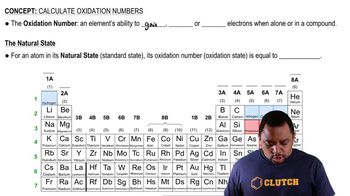
Oxidation states indicate the degree of oxidation of an atom in a compound, reflecting the number of electrons lost, gained, or shared. For chalcogens (group 6A), the most common oxidation state is -2, as they typically gain two electrons to achieve a stable electron configuration. In contrast, halogens (group 7A) usually exhibit a -1 oxidation state, as they tend to gain one electron.
Video consigliato:
Percorso guidato
02:42
Oxidation Numbers

Periodic Table Groups

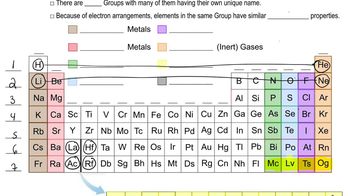
The periodic table is organized into groups (columns) that share similar chemical properties. Group 6A, the chalcogens, includes elements like oxygen and sulfur, which are known for forming compounds with a -2 oxidation state. Group 7A, the halogens, includes elements like fluorine and chlorine, which are highly reactive and typically have a -1 oxidation state due to their tendency to gain one electron.
Video consigliato:
Percorso guidato
05:33
Periodic Table: Group Names

Chemical Reactivity

Chemical reactivity refers to how readily an element undergoes chemical reactions, influenced by its electron configuration. Halogens are more reactive than chalcogens because they are one electron short of a full valence shell, making them eager to gain that electron. Chalcogens, while also reactive, are less so than halogens, as they are two electrons away from achieving a stable configuration.
Video consigliato:
Percorso guidato
03:31
Chemical Properties