
Ch.8 - Basic Concepts of Chemical Bonding
Brown - Chemistry: The Central Science 14th Edition
Brown14th EditionChemistry: The Central ScienceISBN: 9780134414232Non è quello che usi tu?Cambia libro di testo
Capitolo 8, Problema 94b

Ortho-Dichlorobenzene, C6H4Cl2, is obtained when two of the adjacent hydrogen atoms in benzene are replaced with Cl atoms. A skeleton of the molecule is shown here. (b) Are there any resonance structures for the molecule? If so, sketch them.

Guida verificata passo dopo passo
1
Ortho-Dichlorobenzene is a derivative of benzene where two adjacent hydrogen atoms are replaced by chlorine atoms, resulting in the molecular formula C_6H_4Cl_2.
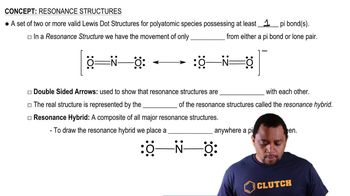
In benzene, resonance structures arise due to the delocalization of electrons within the conjugated pi system of the carbon ring.
For ortho-dichlorobenzene, the presence of chlorine atoms affects the electron distribution, but the basic benzene ring structure still allows for resonance.
To determine if resonance structures exist, consider the movement of pi electrons around the benzene ring, keeping in mind that the chlorine atoms can participate in resonance due to their lone pairs.
Sketch the resonance structures by showing the possible locations of double bonds and the delocalization of electrons, ensuring that the overall structure maintains the aromatic stability of the benzene ring.

Risposta video verificata per un problema simile:

Questa soluzione video è stata consigliata dai nostri tutor come utile per risolvere questo problema.
Durata del video:
1m

Concetti chiave

Ecco i concetti essenziali che devi comprendere per rispondere correttamente alla domanda.

Resonance Structures

Resonance structures are different ways of drawing a molecule that represent the same arrangement of atoms but differ in the distribution of electrons. In molecules like ortho-dichlorobenzene, resonance helps to illustrate how electrons are delocalized across the structure, affecting stability and reactivity. These structures are not real, but rather a way to visualize the electron distribution in a molecule.
Video consigliato:
Percorso guidato
01:42
Resonance Structures

Delocalization of Electrons

Delocalization of electrons refers to the phenomenon where electrons are not confined to a single bond or atom but are spread out over several atoms. In ortho-dichlorobenzene, the presence of resonance allows for the electrons in the π system to be shared among multiple carbon atoms, which contributes to the molecule's stability and influences its chemical properties.
Video consigliato:
Percorso guidato
04:44
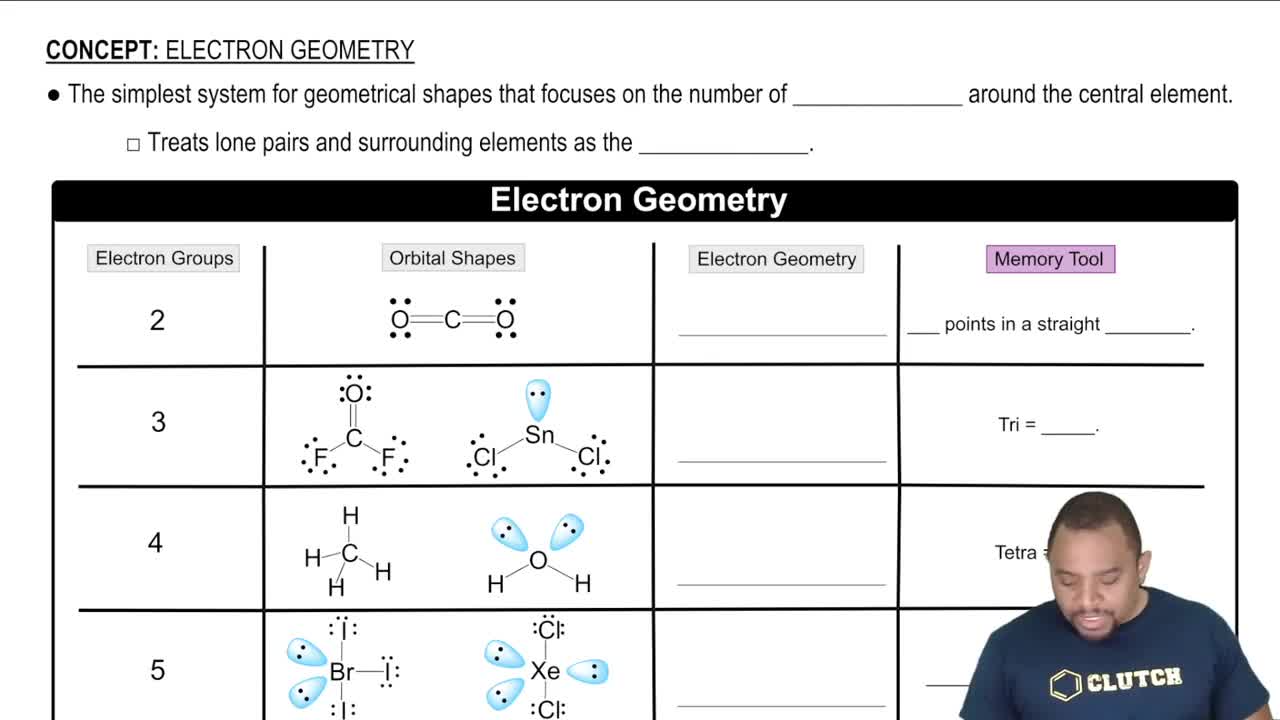
Electron Geometry

Molecular Geometry and Hybridization

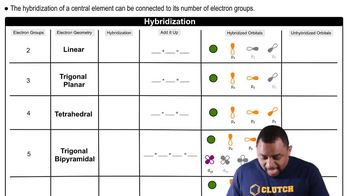
Molecular geometry and hybridization describe the spatial arrangement of atoms in a molecule and the mixing of atomic orbitals to form new hybrid orbitals. In ortho-dichlorobenzene, the carbon atoms are sp² hybridized, leading to a planar structure that allows for effective overlap of p orbitals, facilitating resonance. Understanding these concepts is crucial for visualizing the molecule's shape and predicting its behavior in chemical reactions.
Video consigliato:
Percorso guidato
03:06
Hybridization and Electron Geometry
Pratica correlata
Domanda del libro di testo

The following three Lewis structures can be drawn for N2O:

(b) The N—N bond length in N2O is 1.12 Å, slightly longer than a typical N≡N bond; and the N—O bond length is 1.19 Å, slightly shorter than a typical N═O bond (see Table 8.4). Based on these data, which resonance structure best represents N2O?

1698
views
Domanda del libro di testo

Ortho-Dichlorobenzene, C6H4Cl2, is obtained when two of the adjacent hydrogen atoms in benzene are replaced with Cl atoms. A skeleton of the molecule is shown here. (a) Complete a Lewis structure for the molecule using bonds and electron pairs as needed.

480
views
Domanda del libro di testo

Two compounds are isomers if they have the same chemical formula but different arrangements of atoms. Use Table 8.3 to estimate H for each of the following gas-phase isomerization reactions and indicate which isomer has the lower enthalpy. (d) Methyl isocyanide → Acetonitrile

1366
views
Domanda del libro di testo

Consider the hypothetical molecule B-A=B. Are the following statements true or false? (a) This molecule cannot exist. (b) If resonance was important, the molecule would have identical A–B bond lengths.

405
views
Domanda del libro di testo

An important reaction for the conversion of natural gas to other useful hydrocarbons is the conversion of methane to ethane. 2 CH4(g) → C2H6(g) + H2(g) In practice, this reaction is carried out in the presence of oxygen, which converts the hydrogen produced into water. 2 CH4(g) + 12 O2(g) → C2H6(g) + H2O(g) Use Table 8.3 to estimate H for these two reactions. Why is the conversion of methane to ethane more favorable when oxygen is used? Why is the conversion of methane to ethane more favorable when oxygen is used?

587
views