


Ch.8 - Basic Concepts of Chemical Bonding
Brown - Chemistry: The Central Science 14th Edition
Brown14th EditionChemistry: The Central ScienceISBN: 9780134414232Non è quello che usi tu?Cambia libro di testo
Capitolo 8, Problema 92b

The following three Lewis structures can be drawn for N2O:
(b) The N—N bond length in N2O is 1.12 Å, slightly longer than a typical N≡N bond; and the N—O bond length is 1.19 Å, slightly shorter than a typical N═O bond (see Table 8.4). Based on these data, which resonance structure best represents N2O?

Guida verificata passo dopo passo
1
Identify the possible resonance structures for N2O. These structures will involve different arrangements of single, double, and triple bonds between the nitrogen and oxygen atoms.
Consider the bond lengths given: N—N bond is 1.12 Å and N—O bond is 1.19 Å. Compare these lengths to typical bond lengths: a typical N≡N bond is shorter than 1.12 Å, and a typical N═O bond is longer than 1.19 Å.
Analyze each resonance structure to determine the type of bonds present between the atoms. For example, one structure might have a N≡N triple bond and a N—O single bond, while another might have a N═N double bond and a N═O double bond.
Evaluate which resonance structure aligns best with the given bond lengths. The structure with a N—N bond length slightly longer than a typical N≡N bond and a N—O bond length slightly shorter than a typical N═O bond is most representative.
Select the resonance structure that best matches the observed bond lengths, indicating the most accurate depiction of the electron distribution in N2O.

Risposta video verificata per un problema simile:

Questa soluzione video è stata consigliata dai nostri tutor come utile per risolvere questo problema.
Durata del video:
2m

Concetti chiave

Ecco i concetti essenziali che devi comprendere per rispondere correttamente alla domanda.

Lewis Structures

Lewis structures are diagrams that represent the bonding between atoms in a molecule and the lone pairs of electrons that may exist. They help visualize the arrangement of electrons and the connectivity of atoms, which is crucial for understanding molecular geometry and reactivity. In the case of N2O, multiple Lewis structures can be drawn to depict different resonance forms, each contributing to the overall electronic structure of the molecule.
Video consigliato:
Percorso guidato
04:28
Lewis Dot Structures: Ions

Resonance

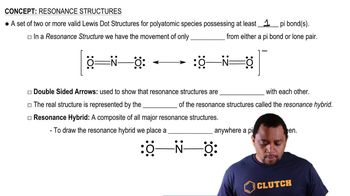
Resonance refers to the concept that some molecules can be represented by two or more valid Lewis structures, known as resonance structures. These structures differ only in the arrangement of electrons, not in the arrangement of atoms. The actual structure of the molecule is a hybrid of these resonance forms, which helps explain properties such as bond lengths and strengths, as seen in the N—N and N—O bonds of N2O.
Video consigliato:
Percorso guidato
01:42
Resonance Structures

Bond Lengths

Bond length is the average distance between the nuclei of two bonded atoms. It is influenced by the type of bond (single, double, triple) and the atoms involved. In N2O, the bond lengths of N—N and N—O provide insight into the nature of the bonding and the stability of the resonance structures, indicating that the actual bond lengths are intermediate between those of typical N≡N and N═O bonds.
Video consigliato:
Percorso guidato
00:36
Average Bond Order