

Ch.8 - Basic Concepts of Chemical Bonding
Brown - Chemistry: The Central Science 14th Edition
Brown14th EditionChemistry: The Central ScienceISBN: 9780134414232Non è quello che usi tu?Cambia libro di testo
Capitolo 8, Problema 26

Which of the following trends in lattice energy is due to differences in ionic radii? (a) LiF > NaF > CsF, (b) CaO > KCl, (c) PbS > Li2O.

Guida verificata passo dopo passo
1
Identify the concept of lattice energy, which is the energy required to separate one mole of an ionic solid into its gaseous ions.
Understand that lattice energy is influenced by the charge of the ions and the distance between them, which is related to the ionic radii.
Recall that smaller ionic radii result in stronger attractions between ions, leading to higher lattice energies.
Analyze the given options: (a) LiF > NaF > CsF, (b) CaO > KCl, (c) PbS > Li2O, and consider the ionic radii of the ions involved.
Determine which trend is primarily due to differences in ionic radii by comparing the sizes of the ions in each pair and how they affect the lattice energy.

Risposta video verificata per un problema simile:

Questa soluzione video è stata consigliata dai nostri tutor come utile per risolvere questo problema.
Durata del video:
11m

Concetti chiave

Ecco i concetti essenziali che devi comprendere per rispondere correttamente alla domanda.

Lattice Energy

Lattice energy is the amount of energy released when gaseous ions combine to form an ionic solid. It is a measure of the strength of the forces between the ions in an ionic compound. Higher lattice energy indicates stronger ionic bonds, which typically results in higher melting points and greater stability of the compound.
Video consigliato:

Ionic Radii

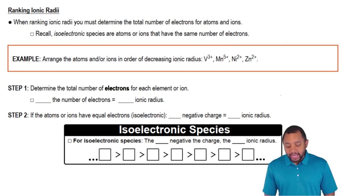
Ionic radii refer to the size of an ion in a crystal lattice. The size of the ions affects the distance between them; smaller ions can pack more closely together, leading to stronger electrostatic attractions and higher lattice energy. Conversely, larger ions result in greater distances and weaker attractions, thus lower lattice energy.
Video consigliato:
Percorso guidato
03:56
Ranking Ionic Radii

Trends in Lattice Energy

Trends in lattice energy can be observed based on the ionic sizes and charges of the ions involved. Generally, as the ionic radius decreases, the lattice energy increases due to stronger attractions between the ions. Additionally, higher charges on the ions also contribute to increased lattice energy, as the electrostatic forces become stronger.
Video consigliato:
Pratica correlata
Domanda del libro di testo

Energy is required to remove two electrons from Ca to form Ca2+, and energy is required to add two electrons to O to form O2 - . Yet CaO is stable relative to the free elements. Which statement is the best explanation? (a) The lattice energy of CaO is large enough to overcome these processes. (b) CaO is a covalent compound, and these processes are irrelevant. (c) CaO has a higher molar mass than either Ca or O. (d) The enthalpy of formation of CaO is small. (e) CaO is stable to atmospheric conditions.

1093
views
Domanda del libro di testo

List the individual steps used in constructing a Born–Haber cycle for the formation of BaI2 from the elements. Which of the steps would you expect to be exothermic?

1089
views
Domanda del libro di testo

(a) Based on the lattice energies of MgCl2 and SrCl2 given in Table 8.1, what is the range of values that you would expect for the lattice energy of CaCl2?

1342
views
Domanda del libro di testo

Consider the ionic compounds KF, NaCl, NaBr, and LiCl. (b) Based on your answer to part (a), arrange these four compounds in order of decreasing lattice energy. (c) Check your predictions in part (b) with the experimental values of lattice energy from Table 8.1. Are the predictions from ionic radii correct?

1
views
Domanda del libro di testo

(b) Arrange the following substances not listed in Table 8.1 according to their expected lattice energies, listing them from lowest lattice energy to the highest: MgS, KI, GaN, LiBr.

Domanda del libro di testo

Consider the ionic compounds KF, NaCl, NaBr, and LiCl. (a) Use ionic radii (Figure 7.8) to estimate the cation–anion distance for each compound.

1074
views