Ch.8 - Basic Concepts of Chemical Bonding
Brown - Chemistry: The Central Science 14th Edition
Brown14th EditionChemistry: The Central ScienceISBN: 9780134414232Non è quello che usi tu?Cambia libro di testo
Capitolo 8, Problema 27

Energy is required to remove two electrons from Ca to form Ca2+, and energy is required to add two electrons to O to form O2 - . Yet CaO is stable relative to the free elements. Which statement is the best explanation? (a) The lattice energy of CaO is large enough to overcome these processes. (b) CaO is a covalent compound, and these processes are irrelevant. (c) CaO has a higher molar mass than either Ca or O. (d) The enthalpy of formation of CaO is small. (e) CaO is stable to atmospheric conditions.

Guida verificata passo dopo passo
1
Identify the type of bonding in CaO. Calcium oxide (CaO) is an ionic compound formed from the metal calcium (Ca) and the nonmetal oxygen (O).
Understand the process of ion formation for Ca and O. Calcium loses two electrons to form Ca2+ (calcium ion), and oxygen gains two electrons to form O2- (oxide ion).
Consider the energy changes involved in the formation of ions. The process of removing electrons from calcium (ionization energy) and adding electrons to oxygen (electron affinity) requires energy.
Examine the concept of lattice energy. Lattice energy is the energy released when the positive and negative ions in an ionic compound form a solid lattice. It is a measure of the compound's stability.
Evaluate the statements given in the problem in the context of ionic bonding and lattice energy. The correct statement should explain why the formation of CaO is energetically favorable despite the initial energy required to form ions.

Risposta video verificata per un problema simile:

Questa soluzione video è stata consigliata dai nostri tutor come utile per risolvere questo problema.
Durata del video:
1m

Concetti chiave

Ecco i concetti essenziali che devi comprendere per rispondere correttamente alla domanda.

Lattice Energy

Lattice energy is the energy released when gaseous ions combine to form an ionic solid. It is a crucial factor in determining the stability of ionic compounds like CaO. A large lattice energy indicates that the electrostatic forces between the ions are strong enough to compensate for the energy required to remove or add electrons, thus stabilizing the compound.
Video consigliato:

Ionization Energy and Electron Affinity

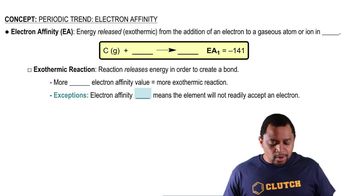
Ionization energy is the energy required to remove an electron from an atom, while electron affinity is the energy change when an electron is added to an atom. In the case of Ca and O, the energy needed to ionize Ca and add electrons to O must be considered when evaluating the overall stability of the resulting ionic compound, CaO.
Video consigliato:
Percorso guidato
01:34
Electron Affinity

Enthalpy of Formation

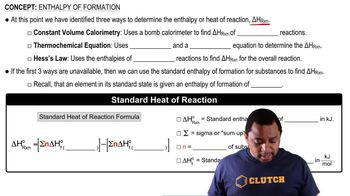
The enthalpy of formation is the change in enthalpy when one mole of a compound is formed from its elements in their standard states. A small enthalpy of formation for CaO suggests that the formation process is energetically favorable, contributing to the stability of the compound despite the energy costs associated with ionization and electron addition.
Video consigliato:
Percorso guidato
02:34
Enthalpy of Formation