Ch.8 - Basic Concepts of Chemical Bonding
Brown - Chemistry: The Central Science 14th Edition
Brown14th EditionChemistry: The Central ScienceISBN: 9780134414232Non è quello che usi tu?Cambia libro di testo
Capitolo 8, Problema 43a

(a) From the data in Table 8.2, calculate the effective charges on the H atom of the HBr molecule in units of the electronic charge, e.

Guida verificata passo dopo passo
1
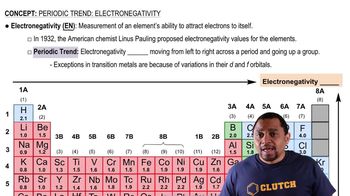
Identify the concept of electronegativity and how it relates to effective charge. Electronegativity is a measure of an atom's ability to attract and hold onto electrons.
Look up the electronegativity values for hydrogen (H) and bromine (Br) from Table 8.2. These values will help determine the polarity of the H-Br bond.
Calculate the difference in electronegativity between Br and H. This difference will indicate the direction and magnitude of the dipole moment in the HBr molecule.
Use the concept of partial charges to express the effective charge on the H atom. The partial charge (δ) can be estimated using the formula: δ = (ΔEN / 4), where ΔEN is the electronegativity difference.
Express the effective charge on the H atom in units of the electronic charge, e, by considering the partial charge calculated in the previous step.

Risposta video verificata per un problema simile:

Questa soluzione video è stata consigliata dai nostri tutor come utile per risolvere questo problema.
Durata del video:
1m

Concetti chiave

Ecco i concetti essenziali che devi comprendere per rispondere correttamente alla domanda.

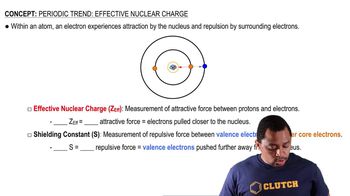
Effective Charge

Effective charge refers to the net charge experienced by an electron in an atom, taking into account the shielding effect of other electrons. In molecules, this concept helps to understand how the distribution of electron density affects the behavior of atoms within a compound, such as HBr, where the hydrogen atom's effective charge can be influenced by the presence of bromine.
Video consigliato:
Percorso guidato
01:51
Effective Nuclear Charge

Electronegativity

Electronegativity is a measure of an atom's ability to attract and hold onto electrons in a chemical bond. In the case of HBr, bromine is significantly more electronegative than hydrogen, which leads to a polar covalent bond. This difference in electronegativity is crucial for calculating the effective charge on the hydrogen atom.
Video consigliato:
Percorso guidato
02:10
Electronegativity Trends

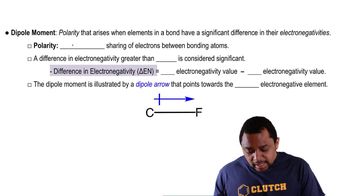
Molecular Dipole Moment

The molecular dipole moment is a vector quantity that represents the separation of positive and negative charges in a molecule. It is influenced by the effective charges on the atoms and their spatial arrangement. In HBr, the dipole moment arises from the unequal sharing of electrons, which is essential for understanding the effective charge on the hydrogen atom.
Video consigliato: