Ch.8 - Basic Concepts of Chemical Bonding
Brown - Chemistry: The Central Science 14th Edition
Brown14th EditionChemistry: The Central ScienceISBN: 9780134414232Non è quello che usi tu?Cambia libro di testo
Capitolo 8, Problema 88b

A major challenge in implementing the 'hydrogen economy' is finding a safe, lightweight, and compact way of storing hydrogen for use as a fuel. The hydrides of light metals are attractive for hydrogen storage because they can store a high weight percentage of hydrogen in a small volume. For example, NaAlH4 can release 5.6% of its mass as H2 upon decomposing to NaH(s), Al(s), and H2(g). NaAlH4 possesses both covalent bonds, which hold polyatomic anions together, and ionic bonds. (b) Which element in NaAlH4 is the most electronegative? Which one is the least electronegative? Which element in NaAlH4 is the least electronegative?

Guida verificata passo dopo passo
1
1. To determine the most and least electronegative elements in NaAlH4, we need to refer to the periodic table. Electronegativity is a measure of the ability of an atom to attract electrons. It increases from left to right across a period and decreases from top to bottom within a group.
2. In the compound NaAlH4, we have the elements Sodium (Na), Aluminum (Al), and Hydrogen (H).
3. Looking at the periodic table, we can see that Hydrogen (H) is the most electronegative element among these three. This is because it is located at the top right of the periodic table (excluding the noble gases).
4. On the other hand, Sodium (Na) is the least electronegative element in NaAlH4. This is because it is located at the far left of the periodic table, where electronegativity values are the lowest.
5. Therefore, Hydrogen (H) is the most electronegative element and Sodium (Na) is the least electronegative element in the compound NaAlH4.

Risposta video verificata per un problema simile:

Questa soluzione video è stata consigliata dai nostri tutor come utile per risolvere questo problema.
Durata del video:
3m

Concetti chiave

Ecco i concetti essenziali che devi comprendere per rispondere correttamente alla domanda.

Electronegativity

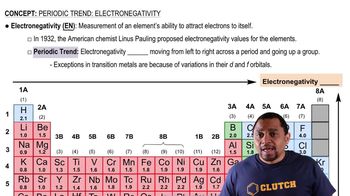
Electronegativity is a measure of an atom's ability to attract and hold onto electrons in a chemical bond. It is a key factor in determining the nature of bonds formed between atoms, influencing molecular polarity and reactivity. The Pauling scale is commonly used to quantify electronegativity, with fluorine being the most electronegative element.
Video consigliato:
Percorso guidato
02:10
Electronegativity Trends

Covalent and Ionic Bonds

Covalent bonds occur when two atoms share electrons, typically between nonmetals, leading to the formation of molecules. In contrast, ionic bonds form when one atom donates electrons to another, resulting in the attraction between positively and negatively charged ions. Understanding these bond types is crucial for analyzing the structure and properties of compounds like NaAlH4.
Video consigliato:
Percorso guidato
01:16
Chemical Bonds Example 1

Hydrides

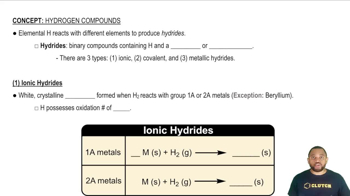
Hydrides are compounds formed between hydrogen and other elements, often metals. They can exist in various forms, including ionic and covalent hydrides, and are significant in hydrogen storage technologies. Light metal hydrides, such as NaAlH4, are particularly noted for their ability to absorb and release hydrogen gas, making them valuable for applications in the hydrogen economy.
Video consigliato:
Pratica correlata
Domanda del libro di testo

Although I3- is a known ion, F3- is not. (b) One of your classmates says that F3- does not exist because F is too electronegative to make bonds with another atom. Give an example that proves your classmate is wrong.

2
views
Domanda del libro di testo

A major challenge in implementing the 'hydrogen economy' is finding a safe, lightweight, and compact way of storing hydrogen for use as a fuel. The hydrides of light metals are attractive for hydrogen storage because they can store a high weight percentage of hydrogen in a small volume. For example, NaAlH4 can release 5.6% of its mass as H2 upon decomposing to NaH(s), Al(s), and H2(g). NaAlH4 possesses both covalent bonds, which hold polyatomic anions together, and ionic bonds. (c) Based on electronegativity differences, predict the identity of the polyatomic anion. Draw a Lewis structure for this ion.

424
views
Domanda del libro di testo

(c) The measured dipole moment of BrCl is 0.57 D. If you assume the bond length in BrCl is the sum of the atomic radii, what are the partial charges on the atoms in BrCl using the experimental dipole moment?

951
views
1
rank
Domanda del libro di testo

(b) Using these partial charges and the atomic radii given in Figure 7.8, estimate the dipole moment of the molecule.

881
views
Domanda del libro di testo

A major challenge in implementing the 'hydrogen economy' is finding a safe, lightweight, and compact way of storing hydrogen for use as a fuel. The hydrides of light metals are attractive for hydrogen storage because they can store a high weight percentage of hydrogen in a small volume. For example, NaAlH4 can release 5.6% of its mass as H2 upon decomposing to NaH(s), Al(s), and H2(g). NaAlH4 possesses both covalent bonds, which hold polyatomic anions together, and ionic bonds. (d) What is the formal charge on hydrogen in the polyatomic ion?

338
views
Domanda del libro di testo

(a) Using the electronegativities of Br and Cl, estimate the partial charges on the atoms in the Br¬Cl molecule.