

Ch.8 - Basic Concepts of Chemical Bonding
Brown - Chemistry: The Central Science 14th Edition
Brown14th EditionChemistry: The Central ScienceISBN: 9780134414232Non è quello che usi tu?Cambia libro di testo
Capitolo 8, Problema 87b

(b) Using these partial charges and the atomic radii given in Figure 7.8, estimate the dipole moment of the molecule.

Guida verificata passo dopo passo
1
Identify the atoms involved in the molecule and their respective partial charges (\( \delta^+ \) and \( \delta^- \)).
Determine the distance between the centers of the two atoms using their atomic radii. This distance is the bond length.
Use the formula for dipole moment: \( \mu = q \times d \), where \( q \) is the magnitude of the charge and \( d \) is the distance between the charges.
Substitute the values of the partial charge (\( q \)) and the bond length (\( d \)) into the formula.
Calculate the dipole moment, ensuring the units are consistent, typically in Debye (D).

Risposta video verificata per un problema simile:

Questa soluzione video è stata consigliata dai nostri tutor come utile per risolvere questo problema.
Durata del video:
6m

Concetti chiave

Ecco i concetti essenziali che devi comprendere per rispondere correttamente alla domanda.

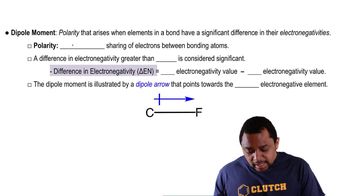
Dipole Moment

The dipole moment is a measure of the separation of positive and negative charges in a molecule. It is a vector quantity, represented by the product of the charge magnitude and the distance between the charges. A higher dipole moment indicates a greater polarity, which affects the molecule's interactions with electric fields and other polar substances.
Video consigliato:

Partial Charges

Partial charges arise in polar covalent bonds where electrons are not shared equally between atoms, leading to a slight positive charge (δ+) on one atom and a slight negative charge (δ-) on the other. These charges are crucial for determining the overall dipole moment of a molecule, as they indicate how charge is distributed within the molecule.
Video consigliato:
Percorso guidato
00:48
Partial Pressure Calculation

Atomic Radii

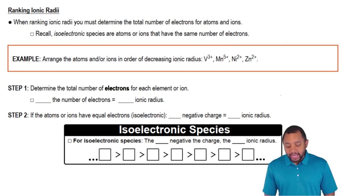
Atomic radii refer to the size of an atom, typically measured as the distance from the nucleus to the outermost electron shell. In the context of dipole moments, atomic radii help estimate the distance between partial charges in a molecule, which is essential for calculating the dipole moment accurately. Understanding atomic radii allows for better predictions of molecular behavior and interactions.
Video consigliato:
Percorso guidato
03:56
Ranking Ionic Radii
Pratica correlata
Domanda del libro di testo

The substance chlorine monoxide, ClO(g), is important in atmospheric processes that lead to depletion of the ozone layer. The ClO molecule has an experimental dipole moment of 1.24 D, and the Cl—O bond length is 160 pm. (c) Using formal charges as a guide, propose the dominant Lewis structure for the molecule. (g), is important in atmospheric processes that lead to depletion of the ozone layer. The ClO molecule has an experimental dipole moment of 1.24 D, and the Cl—O bond length is 160 pm. (d) The anion ClO exists. What is the formal charge on the Cl for the best Lewis structure for ClO-?

1
views
Domanda del libro di testo

A major challenge in implementing the 'hydrogen economy' is finding a safe, lightweight, and compact way of storing hydrogen for use as a fuel. The hydrides of light metals are attractive for hydrogen storage because they can store a high weight percentage of hydrogen in a small volume. For example, NaAlH4 can release 5.6% of its mass as H2 upon decomposing to NaH(s), Al(s), and H2(g). NaAlH4 possesses both covalent bonds, which hold polyatomic anions together, and ionic bonds. (c) Based on electronegativity differences, predict the identity of the polyatomic anion. Draw a Lewis structure for this ion.

424
views
Domanda del libro di testo

(c) The measured dipole moment of BrCl is 0.57 D. If you assume the bond length in BrCl is the sum of the atomic radii, what are the partial charges on the atoms in BrCl using the experimental dipole moment?

951
views
1
rank
Domanda del libro di testo

The substance chlorine monoxide, ClO(g), is important in atmospheric processes that lead to depletion of the ozone layer. The ClO molecule has an experimental dipole moment of 1.24 D, and the Cl—O bond length is 160 pm. (b) Based on the electronegativities of the elements, which atom would you expect to have a partial negative charge in the ClO molecule?

987
views
Domanda del libro di testo

A major challenge in implementing the 'hydrogen economy' is finding a safe, lightweight, and compact way of storing hydrogen for use as a fuel. The hydrides of light metals are attractive for hydrogen storage because they can store a high weight percentage of hydrogen in a small volume. For example, NaAlH4 can release 5.6% of its mass as H2 upon decomposing to NaH(s), Al(s), and H2(g). NaAlH4 possesses both covalent bonds, which hold polyatomic anions together, and ionic bonds. (b) Which element in NaAlH4 is the most electronegative? Which one is the least electronegative? Which element in NaAlH4 is the least electronegative?

365
views
Domanda del libro di testo

(a) Using the electronegativities of Br and Cl, estimate the partial charges on the atoms in the Br¬Cl molecule.