Ch.8 - Basic Concepts of Chemical Bonding
Brown - Chemistry: The Central Science 14th Edition
Brown14th EditionChemistry: The Central ScienceISBN: 9780134414232Non è quello che usi tu?Cambia libro di testo
Capitolo 8, Problema 110

Ammonium chloride, NH4Cl, is a very soluble salt in water. (a) Draw the Lewis structures of the ammonium and chloride ions.

Guida verificata passo dopo passo
1
To draw the Lewis structure of the ammonium ion (NH_4^+), start by identifying the total number of valence electrons. Nitrogen (N) has 5 valence electrons, and each hydrogen (H) has 1 valence electron. Since the ion has a +1 charge, subtract one electron from the total.
Arrange the atoms with nitrogen in the center and the four hydrogen atoms surrounding it.
Distribute the electrons to form bonds between the nitrogen and each hydrogen atom. Each N-H bond will consist of a pair of shared electrons.
For the chloride ion (Cl^-), start by identifying the total number of valence electrons. Chlorine (Cl) has 7 valence electrons, and since it has a -1 charge, add one extra electron to the total.
Place the chloride ion's electrons around the Cl symbol, ensuring that it has a complete octet (8 electrons) around it.

Risposta video verificata per un problema simile:

Questa soluzione video è stata consigliata dai nostri tutor come utile per risolvere questo problema.
Durata del video:
1m

Concetti chiave

Ecco i concetti essenziali che devi comprendere per rispondere correttamente alla domanda.

Lewis Structures

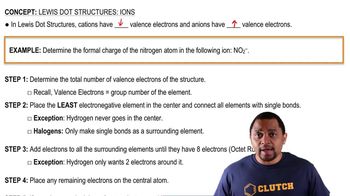
Lewis structures are diagrams that represent the bonding between atoms in a molecule and the lone pairs of electrons that may exist. They use dots to represent valence electrons and lines to indicate bonds between atoms. Understanding how to draw Lewis structures is essential for visualizing molecular geometry and predicting the behavior of molecules in chemical reactions.
Video consigliato:
Percorso guidato
04:28
Lewis Dot Structures: Ions

Ionic Compounds

Ionic compounds are formed when atoms transfer electrons, resulting in the formation of positively charged cations and negatively charged anions. In the case of ammonium chloride, NH4Cl, the ammonium ion (NH4+) acts as a cation, while the chloride ion (Cl-) serves as the anion. Recognizing the nature of ionic bonds helps in understanding the properties of salts, such as solubility in water.
Video consigliato:
Percorso guidato
02:11
Ionic Compounds Naming

Solubility in Water

Solubility refers to the ability of a substance to dissolve in a solvent, such as water. Ammonium chloride is highly soluble due to the strong interactions between the ions and water molecules, which stabilize the ions in solution. This concept is crucial for predicting how ionic compounds behave in aqueous environments and their applications in various chemical processes.
Video consigliato:
Percorso guidato
02:07
Solubility and Insolubility