Ch.8 - Basic Concepts of Chemical Bonding
Brown - Chemistry: The Central Science 14th Edition
Brown14th EditionChemistry: The Central ScienceISBN: 9780134414232Non è quello che usi tu?Cambia libro di testo
Capitolo 8, Problema 108b

Trifluoroacetic acid has the chemical formula CF3CO2H. It is a colorless liquid that has a density of 1.489 g/mL. (b) Trifluoroacetic acid can react with NaOH in aqueous solution to produce the trifluoroacetate ion, CF3COO2. Write the balanced chemical equation for this reaction.

Guida verificata passo dopo passo
1
Identify the reactants and products in the reaction: Trifluoroacetic acid (CF_3CO_2H) reacts with sodium hydroxide (NaOH) to produce sodium trifluoroacetate (CF_3COONa) and water (H_2O).
Write the unbalanced chemical equation: CF_3CO_2H + NaOH \(\rightarrow\) CF_3COONa + H_2O.
Balance the equation by ensuring the number of each type of atom is the same on both sides of the equation.
Check that the number of carbon, fluorine, oxygen, hydrogen, and sodium atoms are equal on both sides of the equation.
Confirm that the charges are balanced, ensuring that the reaction is neutral overall.

Risposta video verificata per un problema simile:

Questa soluzione video è stata consigliata dai nostri tutor come utile per risolvere questo problema.
Durata del video:
2m

Concetti chiave

Ecco i concetti essenziali che devi comprendere per rispondere correttamente alla domanda.

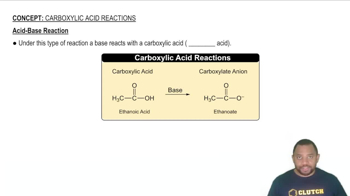
Acid-Base Reactions

Acid-base reactions involve the transfer of protons (H+) from an acid to a base. In this case, trifluoroacetic acid (CF3CO2H) acts as the acid, donating a proton to sodium hydroxide (NaOH), which acts as the base. Understanding this concept is crucial for writing the balanced chemical equation for the reaction.
Video consigliato:
Percorso guidato
01:09
Acid-Base Reaction

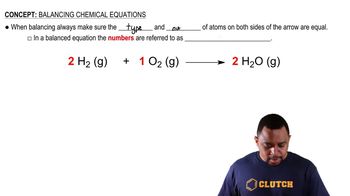
Balanced Chemical Equations

A balanced chemical equation represents a chemical reaction with equal numbers of each type of atom on both sides of the equation. This ensures the law of conservation of mass is upheld. To write the balanced equation for the reaction between trifluoroacetic acid and NaOH, one must account for all reactants and products, including the formation of the trifluoroacetate ion.
Video consigliato:
Percorso guidato
01:32
Balancing Chemical Equations

Ionic Compounds in Aqueous Solution

In aqueous solutions, ionic compounds dissociate into their constituent ions. Sodium hydroxide (NaOH) dissociates into Na+ and OH- ions in water. Recognizing how these ions interact with the trifluoroacetic acid is essential for understanding the reaction mechanism and predicting the products formed in the balanced equation.
Video consigliato:
Percorso guidato
01:11
Types of Aqueous Solutions