
Ch.8 - Basic Concepts of Chemical Bonding
Brown - Chemistry: The Central Science 14th Edition
Brown14th EditionChemistry: The Central ScienceISBN: 9780134414232Non è quello che usi tu?Cambia libro di testo
Capitolo 8, Problema 59b

(b) Which of these compounds or ions is an exception to the octet rule: borohydride (BH4-), borazine (B3N3H6, which is analogous to benzene with alternating B and N in the ring), or boron trichloride?

Guida verificata passo dopo passo
1
Identify the octet rule, which states that atoms tend to form compounds in ways that give them eight valence electrons, achieving a noble gas configuration.
Examine the structure of borohydride (BH4-): Boron typically forms three bonds, but in BH4-, it forms four bonds, achieving an octet by sharing electrons with hydrogen atoms.
Analyze borazine (B3N3H6): Boron and nitrogen alternate in a ring structure similar to benzene. Boron typically does not achieve a full octet in such structures, as it forms three bonds and has six valence electrons.
Consider boron trichloride (BCl3): Boron forms three bonds with chlorine atoms, resulting in only six valence electrons around boron, which is less than an octet.
Conclude that boron trichloride (BCl3) is an exception to the octet rule, as boron does not achieve a full octet in this compound.

Risposta video verificata per un problema simile:

Questa soluzione video è stata consigliata dai nostri tutor come utile per risolvere questo problema.
Durata del video:
3m

Concetti chiave

Ecco i concetti essenziali che devi comprendere per rispondere correttamente alla domanda.

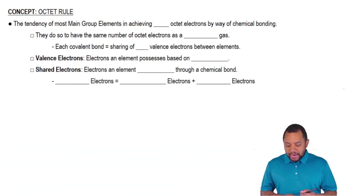
Octet Rule

The octet rule is a chemical guideline stating that atoms tend to bond in such a way that they each have eight electrons in their valence shell, achieving a stable electron configuration similar to that of noble gases. This rule primarily applies to main group elements and helps predict the bonding behavior of atoms in molecules.
Video consigliato:

Electron Deficiency

Electron deficiency occurs when an atom does not have enough electrons to complete its octet, often seen in compounds with elements from group 13, such as boron. These compounds can form stable structures despite having fewer than eight electrons around the central atom, leading to exceptions to the octet rule.
Video consigliato:
Percorso guidato
04:44
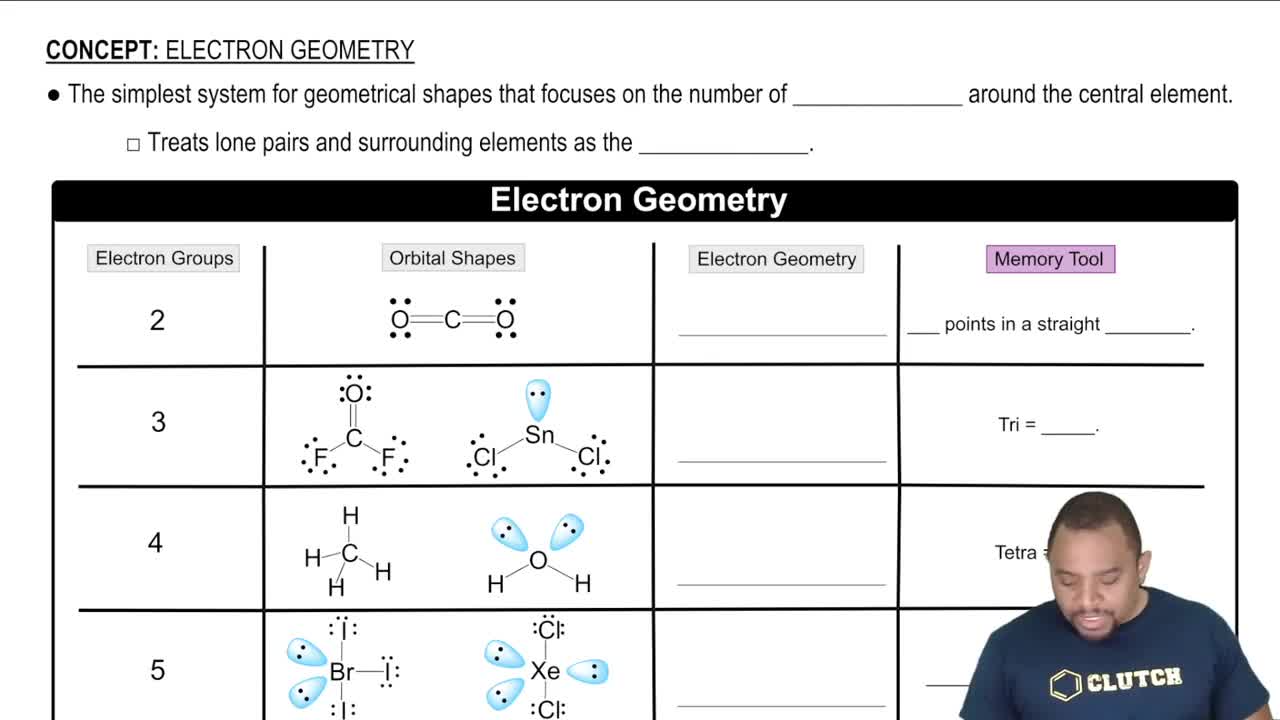
Electron Geometry

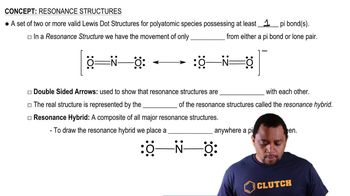
Resonance Structures

Resonance structures are different ways of drawing the same molecule that illustrate the delocalization of electrons. In compounds like borazine, resonance can help explain the stability and bonding characteristics that deviate from the octet rule, as the electrons are shared among multiple atoms rather than localized.
Video consigliato:
Percorso guidato
01:42
Resonance Structures