
Mothballs are composed of naphthalene, C10H8, a molecule that consists of two six-membered rings of carbon fused along an edge, as shown in this incomplete Lewis structure:(a) Draw all of the resonance structures of naphthalene. How many are there?
Ch.8 - Basic Concepts of Chemical Bonding
Brown14th EditionChemistry: The Central ScienceISBN: 9780134414232Non è quello che usi tu?Cambia libro di testo
Capitolo 8, Problema 58c
Mothballs are composed of naphthalene, C10H8, a molecule that consists of two six-membered rings of carbon fused along an edge, as shown in this incomplete Lewis structure:
(c) Not all of the C—C bond lengths in naphthalene are equivalent. Based on your resonance structures, how many C—C bonds in the molecule do you expect to be shorter than the others?
Guida verificata passo dopo passo1
Draw the Lewis structure of naphthalene, C_{10}H_{8}, showing all atoms and bonds.
Identify the resonance structures of naphthalene by moving electrons to form different double bond arrangements.
Count the number of C—C bonds in each resonance structure.
Determine which C—C bonds are double bonds in more than one resonance structure, as these will be shorter due to increased bond order.
Conclude how many C—C bonds are expected to be shorter based on their presence as double bonds in multiple resonance structures.

Risposta video verificata per un problema simile:
Questa soluzione video è stata consigliata dai nostri tutor come utile per risolvere questo problema.
Durata del video:
2mConcetti chiave
Ecco i concetti essenziali che devi comprendere per rispondere correttamente alla domanda.
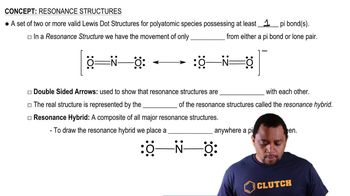
Resonance Structures
Resonance structures are different ways of drawing the same molecule that illustrate the delocalization of electrons. In naphthalene, the electrons in the C—C bonds can be shared among multiple bonds, leading to bond lengths that are not all equivalent. Understanding resonance helps predict the stability and reactivity of the molecule.
Video consigliato:
Percorso guidato
Resonance Structures
Bond Lengths and Strengths
Bond length refers to the distance between the nuclei of two bonded atoms. In molecules with resonance, some bonds can be shorter or longer than others due to the distribution of electron density. In naphthalene, the C—C bonds that participate in resonance are typically shorter and stronger than those that do not.
Video consigliato:
Percorso guidato
Average Bond Order
Delocalization of Electrons
Delocalization of electrons occurs when electrons are not associated with a single atom or bond but are spread over several atoms. In naphthalene, this delocalization results from the overlapping p-orbitals of the carbon atoms, leading to a stabilization of the molecule and affecting the bond lengths of the C—C bonds.
Video consigliato:
Percorso guidato
Electron Geometry
Pratica correlata
Domanda del libro di testo
762
views
Domanda del libro di testo
(a) Which of these compounds is an exception to the octet rule: carbon dioxide, water, ammonia, phosphorus trifluoride, or arsenic pentafluoride?
Domanda del libro di testo
Mothballs are composed of naphthalene, C10H8, a molecule that consists of two six-membered rings of carbon fused along an edge, as shown in this incomplete Lewis structure:
(b) Do you expect the C—C bond lengths in the molecule to be similar to those of C—C single bonds, C ═C double bonds, or intermediate between C—C single and C ═C double bonds?
559
views
Domanda del libro di testo
(b) Which of these compounds or ions is an exception to the octet rule: borohydride (BH4-), borazine (B3N3H6, which is analogous to benzene with alternating B and N in the ring), or boron trichloride?
975
views
