Ch.8 - Basic Concepts of Chemical Bonding
Brown - Chemistry: The Central Science 14th Edition
Brown14th EditionChemistry: The Central ScienceISBN: 9780134414232Non è quello che usi tu?Cambia libro di testo
Capitolo 8, Problema 40a,b

By referring only to the periodic table, select (a) the most electronegative element in group 13; (b) the least electronegative element in the group As, Se and Br;

Guida verificata passo dopo passo
1
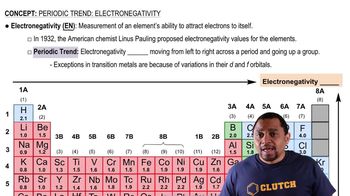
Step 1: Understand the concept of electronegativity. Electronegativity is a measure of an atom's ability to attract and hold onto electrons. It generally increases across a period and decreases down a group in the periodic table.
Step 2: Locate group 13 on the periodic table. Group 13 elements include B (Boron), Al (Aluminum), Ga (Gallium), In (Indium), and Tl (Thallium). Electronegativity tends to decrease as you move down the group.
Step 3: Identify the most electronegative element in group 13. Since electronegativity decreases down the group, the element at the top of the group, Boron (B), is the most electronegative.
Step 4: Compare the electronegativities of As (Arsenic), Se (Selenium), and Br (Bromine). These elements are located in different groups and periods, so refer to their positions on the periodic table to determine their relative electronegativities.
Step 5: Determine the least electronegative element among As, Se, and Br. Electronegativity generally increases across a period, so the element furthest to the left (As) is typically the least electronegative.

Risposta video verificata per un problema simile:

Questa soluzione video è stata consigliata dai nostri tutor come utile per risolvere questo problema.
Durata del video:
1m

Concetti chiave

Ecco i concetti essenziali che devi comprendere per rispondere correttamente alla domanda.

Electronegativity

Electronegativity is a measure of an atom's ability to attract and hold onto electrons in a chemical bond. It is a key factor in determining how atoms interact with each other, influencing bond polarity and molecular structure. The electronegativity values are often referenced from the Pauling scale, where higher values indicate a stronger tendency to attract electrons.
Video consigliato:
Percorso guidato
02:10
Electronegativity Trends

Periodic Trends

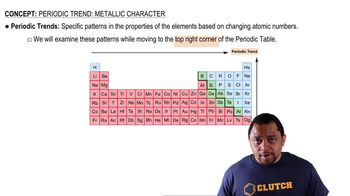
Periodic trends refer to the predictable patterns observed in the properties of elements as you move across or down the periodic table. Electronegativity generally increases across a period from left to right and decreases down a group. Understanding these trends helps in predicting the behavior of elements, including their reactivity and bonding characteristics.
Video consigliato:
Percorso guidato
00:38
Periodic Trends

Group 13 Elements

Group 13 of the periodic table includes elements such as boron, aluminum, gallium, indium, and thallium. These elements exhibit unique properties, including varying electronegativities. In this group, boron is the most electronegative element, while the other elements show decreasing electronegativity as you move down the group, which is essential for answering questions related to their chemical behavior.
Video consigliato:
Percorso guidato
00:50
Main Group Elements: Density Example