Ch.8 - Basic Concepts of Chemical Bonding
Brown - Chemistry: The Central Science 14th Edition
Brown14th EditionChemistry: The Central ScienceISBN: 9780134414232Non è quello che usi tu?Cambia libro di testo
Capitolo 8, Problema 40d

By referring only to the periodic table, select (d) the element in the group K, C, Zn, F that is most likely to form an ionic compound with Ba.

Guida verificata passo dopo passo
1
Identify the group of each element: K (Potassium) is in Group 1, C (Carbon) is in Group 14, Zn (Zinc) is in Group 12, and F (Fluorine) is in Group 17.
Recall that ionic compounds are typically formed between metals and nonmetals, where metals lose electrons and nonmetals gain electrons.
Recognize that Ba (Barium) is an alkaline earth metal in Group 2, which tends to form +2 cations.
Determine which element among K, C, Zn, and F is a nonmetal and can gain electrons to form an anion.
Conclude that the element most likely to form an ionic compound with Ba is the nonmetal that can accept electrons from Ba to form a stable ionic bond.

Risposta video verificata per un problema simile:

Questa soluzione video è stata consigliata dai nostri tutor come utile per risolvere questo problema.
Durata del video:
1m

Concetti chiave

Ecco i concetti essenziali che devi comprendere per rispondere correttamente alla domanda.

Ionic Compounds

Ionic compounds are formed when atoms transfer electrons, resulting in the formation of positively and negatively charged ions. Typically, this occurs between metals, which lose electrons, and nonmetals, which gain electrons. The electrostatic attraction between these oppositely charged ions leads to the formation of a stable ionic lattice structure.
Video consigliato:
Percorso guidato
02:11
Ionic Compounds Naming

Periodic Table Groups

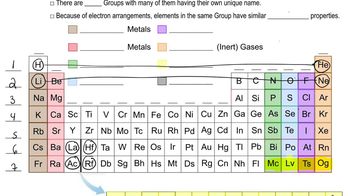
Elements in the periodic table are organized into groups based on their similar chemical properties. Group K (alkali metals) and Group F (halogens) are particularly relevant here, as alkali metals tend to lose one electron to form cations, while halogens typically gain one electron to form anions. Understanding the behavior of these groups helps predict how elements will interact with each other.
Video consigliato:
Percorso guidato
05:33
Periodic Table: Group Names

Barium's Reactivity

Barium (Ba) is an alkaline earth metal that readily forms ionic compounds, typically by losing two electrons to form a Ba²⁺ ion. When considering potential ionic compounds with other elements, it is essential to identify which element can effectively gain or lose electrons to balance the charge. In this case, the most suitable partner for Ba would be an element that can form a stable ionic bond by achieving a full outer electron shell.
Video consigliato:
Percorso guidato
01:41
Physical Properties Example