Ch.8 - Basic Concepts of Chemical Bonding
Brown - Chemistry: The Central Science 14th Edition
Brown14th EditionChemistry: The Central ScienceISBN: 9780134414232Non è quello che usi tu?Cambia libro di testo
Capitolo 8, Problema 36c

(c) Do you expect the O—O bond in H2O2 to be longer or shorter than the O—O bond in O2? Explain.

Guida verificata passo dopo passo
1
Identify the molecular structure of both H2O2 (hydrogen peroxide) and O2 (oxygen gas). Hydrogen peroxide has a bent structure due to the presence of lone pairs on oxygen atoms, while oxygen gas is a diatomic molecule with a double bond between the oxygen atoms.
Consider the types of bonds present in each molecule. In H2O2, the oxygen atoms are connected by a single bond, whereas in O2, the oxygen atoms are connected by a double bond.
Recall that double bonds are generally shorter and stronger than single bonds due to the increased electron density between the atoms.
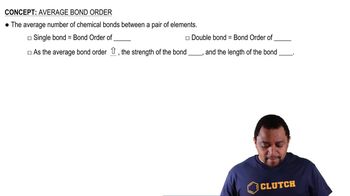
Apply the concept that the length of the bond is inversely related to the bond order (number of chemical bonds between a pair of atoms). A higher bond order typically results in a shorter bond.
Conclude that based on the bond order and the type of bonding, the O—O bond in O2 (double bond) is expected to be shorter than the O—O bond in H2O2 (single bond).

Risposta video verificata per un problema simile:

Questa soluzione video è stata consigliata dai nostri tutor come utile per risolvere questo problema.
Durata del video:
5m

Concetti chiave

Ecco i concetti essenziali che devi comprendere per rispondere correttamente alla domanda.

Bond Length

Bond length refers to the distance between the nuclei of two bonded atoms. It is influenced by factors such as atomic size, bond order, and the presence of lone pairs. Generally, shorter bonds indicate stronger interactions between atoms, while longer bonds suggest weaker interactions.
Video consigliato:
Percorso guidato
00:36
Average Bond Order

Bond Order

Bond order is a measure of the number of chemical bonds between a pair of atoms. In simple terms, a higher bond order (e.g., double or triple bonds) typically results in shorter bond lengths due to increased electron sharing. In contrast, a single bond has a lower bond order and is usually longer.
Video consigliato:
Percorso guidato
00:36
Average Bond Order

Lone Pairs and Steric Effects

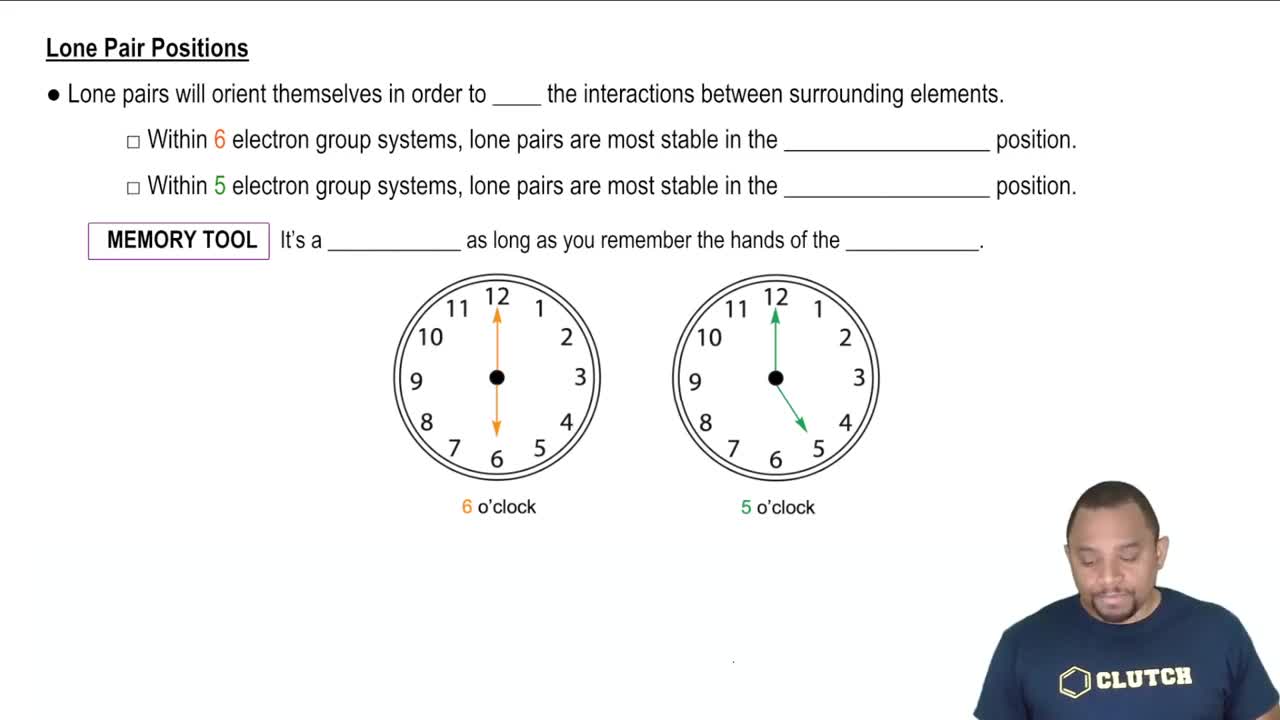
Lone pairs are pairs of valence electrons that are not involved in bonding. In molecules like H2O2, the presence of lone pairs on oxygen atoms can create repulsive forces that affect bond lengths. This steric effect can lead to longer bond lengths compared to molecules with fewer or no lone pairs, such as O2.
Video consigliato:
Percorso guidato
01:33
Lone Pair Positions