
Ch.8 - Basic Concepts of Chemical Bonding
Brown - Chemistry: The Central Science 14th Edition
Brown14th EditionChemistry: The Central ScienceISBN: 9780134414232Non è quello che usi tu?Cambia libro di testo
Capitolo 8, Problema 79a

Consider the lattice energies of the following Group 2A compounds: BeH2, 3205 kJ/mol; MgH2, 2791 kJ/mol; CaH2, 2410 kJ/mol; SrH2, 2250 kJ/mol; BaH2, 2121 kJ/mol. (a) What is the oxidation number of H in these compounds?

Guida verificata passo dopo passo
1
insert step 1: Understand that the oxidation number is a concept used to keep track of electrons in chemical reactions, particularly redox reactions.
insert step 2: Recognize that hydrogen typically has an oxidation number of +1 when bonded to nonmetals and -1 when bonded to metals.
insert step 3: Identify that in Group 2A metal hydrides (e.g., BeH2, MgH2), hydrogen is bonded to metals.
insert step 4: Conclude that since hydrogen is bonded to metals in these compounds, it will have an oxidation number of -1.
insert step 5: Verify that the sum of oxidation numbers in a neutral compound is zero, which supports hydrogen having an oxidation number of -1 in these metal hydrides.

Risposta video verificata per un problema simile:

Questa soluzione video è stata consigliata dai nostri tutor come utile per risolvere questo problema.
Durata del video:
1m

Concetti chiave

Ecco i concetti essenziali che devi comprendere per rispondere correttamente alla domanda.

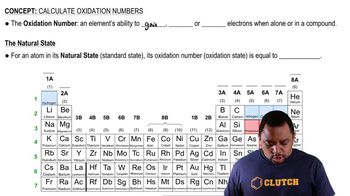
Oxidation Number

The oxidation number, or oxidation state, is a theoretical charge assigned to an atom in a compound based on the assumption that electrons are completely transferred. In compounds, hydrogen typically has an oxidation number of +1 when bonded to nonmetals and -1 when bonded to metals. Understanding this concept is crucial for determining the oxidation states of elements in various compounds.
Video consigliato:
Percorso guidato
02:42
Oxidation Numbers

Group 2A Elements

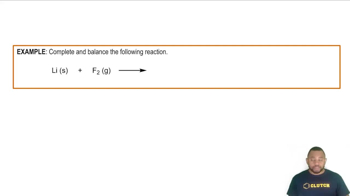
Group 2A elements, also known as alkaline earth metals, include beryllium (Be), magnesium (Mg), calcium (Ca), strontium (Sr), and barium (Ba). These elements typically have an oxidation state of +2 in their compounds due to the loss of their two outermost electrons. Recognizing the behavior of these metals helps in predicting the oxidation states of hydrogen in their hydrides.
Video consigliato:
Percorso guidato
00:40
Group 1A and 2A Reactions Example

Hydrides

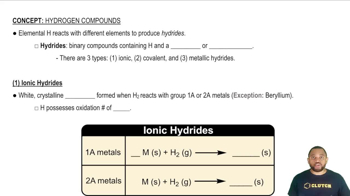
Hydrides are compounds formed between hydrogen and other elements, where hydrogen can exhibit different oxidation states. In the case of alkaline earth metal hydrides, hydrogen is usually in the -1 oxidation state when bonded to metals. This understanding is essential for analyzing the oxidation states in the given Group 2A hydrides.
Video consigliato: