
Ch.8 - Basic Concepts of Chemical Bonding
Brown - Chemistry: The Central Science 14th Edition
Brown14th EditionChemistry: The Central ScienceISBN: 9780134414232Non è quello che usi tu?Cambia libro di testo
Capitolo 8, Problema 79c

Consider the lattice energies of the following Group 2A compounds: BeH2, 3205 kJ/mol; MgH2, 2791 kJ/mol; CaH2, 2410 kJ/mol; SrH2, 2250 kJ/mol; BaH2, 2121 kJ/mol. (c) Consider BeH2. Does it require 3205 kJ of energy to break one mole of the solid into its ions, or does breaking up one mole of solid into its ions release 3205 kJ of energy?

Guida verificata passo dopo passo
1
Understand the concept of lattice energy: Lattice energy is the energy required to separate one mole of an ionic solid into its gaseous ions. It is always a positive value because energy is required to overcome the electrostatic forces holding the ions together in the solid.
Identify the given lattice energy for BeH2: The problem states that the lattice energy for BeH2 is 3205 kJ/mol.
Interpret the meaning of the lattice energy value: Since lattice energy is defined as the energy required to break the solid into its ions, a value of 3205 kJ/mol means that 3205 kJ of energy is needed to break one mole of BeH2 solid into its gaseous ions.
Clarify the direction of energy flow: The positive sign of the lattice energy indicates that energy is absorbed in the process of breaking the solid into ions, not released.
Conclude the interpretation: Therefore, it requires 3205 kJ of energy to break one mole of BeH2 solid into its ions, rather than releasing 3205 kJ of energy.

Risposta video verificata per un problema simile:

Questa soluzione video è stata consigliata dai nostri tutor come utile per risolvere questo problema.
Durata del video:
2m

Concetti chiave

Ecco i concetti essenziali che devi comprendere per rispondere correttamente alla domanda.

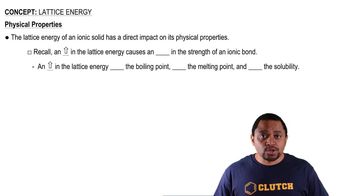
Lattice Energy

Lattice energy is the amount of energy released when one mole of an ionic solid forms from its gaseous ions. It is also the energy required to break the ionic solid into its constituent ions. A higher lattice energy indicates a stronger ionic bond, which typically results from smaller ions or higher charges.
Video consigliato:

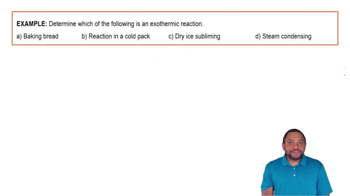
Endothermic vs. Exothermic Processes

An endothermic process absorbs energy from the surroundings, while an exothermic process releases energy. In the context of lattice energy, breaking a solid into ions is an endothermic process, requiring energy input, whereas the formation of the solid from ions is exothermic, releasing energy.
Video consigliato:
Percorso guidato
1:48
Endothermic & Exothermic Reactions Example 2

Thermodynamic Sign Convention

In thermodynamics, the sign convention for energy changes is crucial. A positive value indicates that energy is absorbed (endothermic), while a negative value indicates that energy is released (exothermic). Understanding this convention helps clarify whether the given lattice energy value corresponds to energy required to break the solid or energy released during its formation.
Video consigliato:
Percorso guidato
01:18
First Law of Thermodynamics