Ch.9 - Molecular Geometry and Bonding Theories
Brown - Chemistry: The Central Science 14th Edition
Brown14th EditionChemistry: The Central ScienceISBN: 9780134414232Non è quello che usi tu?Cambia libro di testo
Capitolo 9, Problema 56

(a) If the valence atomic orbitals of an atom are sp hybridized, how many unhybridized p orbitals remain in the valence shell? How many p bonds can the atom form?

Guida verificata passo dopo passo
1
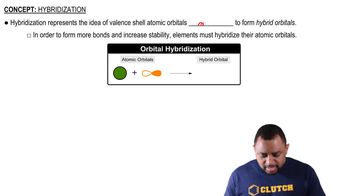
Understand the concept of hybridization: Hybridization is the process of mixing atomic orbitals to form new hybrid orbitals suitable for the pairing of electrons to form chemical bonds in molecules.
Identify the type of hybridization: In sp hybridization, one s orbital and one p orbital mix to form two equivalent sp hybrid orbitals.
Determine the number of unhybridized p orbitals: Since one p orbital is used in hybridization, there are two remaining unhybridized p orbitals in the valence shell.
Understand the formation of pi bonds: Pi (π) bonds are formed by the sideways overlap of unhybridized p orbitals.
Calculate the number of pi bonds: With two unhybridized p orbitals available, the atom can form two pi bonds.

Concetti chiave

Ecco i concetti essenziali che devi comprendere per rispondere correttamente alla domanda.

Hybridization

Hybridization is the process of combining atomic orbitals to form new hybrid orbitals that are suitable for the pairing of electrons to form chemical bonds. In sp hybridization, one s orbital and one p orbital mix to create two equivalent sp hybrid orbitals, which are oriented 180 degrees apart, suitable for forming linear geometries.
Video consigliato:

Valence Shell and Orbitals

The valence shell is the outermost shell of an atom that contains the valence electrons, which are involved in chemical bonding. In the case of sp hybridization, two of the three p orbitals are used in hybridization, leaving one unhybridized p orbital in the valence shell, which can participate in bonding.
Video consigliato:
Percorso guidato
00:47
Valence Shell Electron Pair Repulsion Theory

P Bonds

P bonds, or pi bonds, are a type of covalent bond that occurs when two lobes of one involved atomic orbital overlap with two lobes of another, typically involving unhybridized p orbitals. An atom with one unhybridized p orbital can form one pi bond, which is often found in double or triple bonds alongside sigma bonds.
Video consigliato: