Ch.9 - Molecular Geometry and Bonding Theories
Brown - Chemistry: The Central Science 14th Edition
Brown14th EditionChemistry: The Central ScienceISBN: 9780134414232Non è quello che usi tu?Cambia libro di testo
Capitolo 9, Problema 55d

(d) Can two s orbitals combine to form a p bond? Explain.

Guida verificata passo dopo passo
1
Understand the nature of atomic orbitals: s orbitals are spherical in shape, while p orbitals are dumbbell-shaped and have directional characteristics.
Recognize the types of bonds: Sigma (σ) bonds are formed by the head-on overlap of orbitals, while pi (π) bonds are formed by the side-to-side overlap of orbitals.
Consider the overlap possibilities: s orbitals can overlap with each other or with other orbitals to form sigma bonds due to their spherical symmetry.
Analyze the formation of pi bonds: Pi bonds require parallel, side-to-side overlap, which is characteristic of p orbitals, not s orbitals.
Conclude based on orbital characteristics: Since s orbitals lack the directional nature needed for side-to-side overlap, they cannot combine to form pi bonds.

Risposta video verificata per un problema simile:

Questa soluzione video è stata consigliata dai nostri tutor come utile per risolvere questo problema.
Durata del video:
46s

Concetti chiave

Ecco i concetti essenziali che devi comprendere per rispondere correttamente alla domanda.

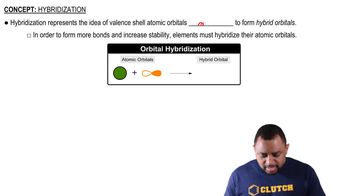
Orbital Hybridization

Orbital hybridization is the process by which atomic orbitals mix to form new hybrid orbitals that can accommodate bonding. In the context of s and p orbitals, hybridization allows for the formation of bonds that are stronger and more directional than those formed by the original atomic orbitals alone.
Video consigliato:

Types of Chemical Bonds

Chemical bonds can be classified into sigma (σ) and pi (π) bonds. Sigma bonds are formed by the head-on overlap of orbitals, while pi bonds result from the side-to-side overlap of p orbitals. Understanding these types of bonds is crucial for determining how different orbitals can combine to form stable molecular structures.
Video consigliato:

Orbital Overlap

Orbital overlap refers to the interaction between atomic orbitals when atoms approach each other to form a bond. For a bond to form, there must be sufficient overlap between the orbitals involved. In the case of s orbitals, they can only form sigma bonds due to their spherical shape, while p orbitals can form both sigma and pi bonds depending on their orientation.
Video consigliato:
Percorso guidato
03:06
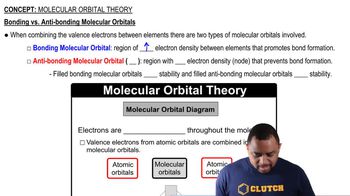
Molecular Orbital Theory