
Ch.9 - Molecular Geometry and Bonding Theories
Brown - Chemistry: The Central Science 14th Edition
Brown14th EditionChemistry: The Central ScienceISBN: 9780134414232Non è quello che usi tu?Cambia libro di testo
Capitolo 9, Problema 96a

a) Predict the electron-domain geometry around the central S atom in SF2, SF4, and SF6.

Guida verificata passo dopo passo
1
Identify the number of electron domains around the sulfur (S) atom in each molecule. Electron domains include both bonding pairs of electrons and lone pairs of electrons.
For SF2: Count the number of bonding pairs and lone pairs on the sulfur atom. Sulfur forms two bonds with fluorine and has lone pairs that also contribute to the electron domain count.
For SF4: Determine the total number of electron domains by counting the sulfur-fluorine bonds and any lone pairs on the sulfur atom.
For SF6: Calculate the total electron domains by counting all the sulfur-fluorine bonds, considering that sulfur in SF6 typically uses all its valence electrons for bonding without lone pairs.
Use the VSEPR (Valence Shell Electron Pair Repulsion) theory to predict the electron-domain geometry for each molecule based on the number of electron domains calculated in the previous steps.

Risposta video verificata per un problema simile:

Questa soluzione video è stata consigliata dai nostri tutor come utile per risolvere questo problema.
Durata del video:
4m

Concetti chiave

Ecco i concetti essenziali che devi comprendere per rispondere correttamente alla domanda.

Electron-Domain Geometry

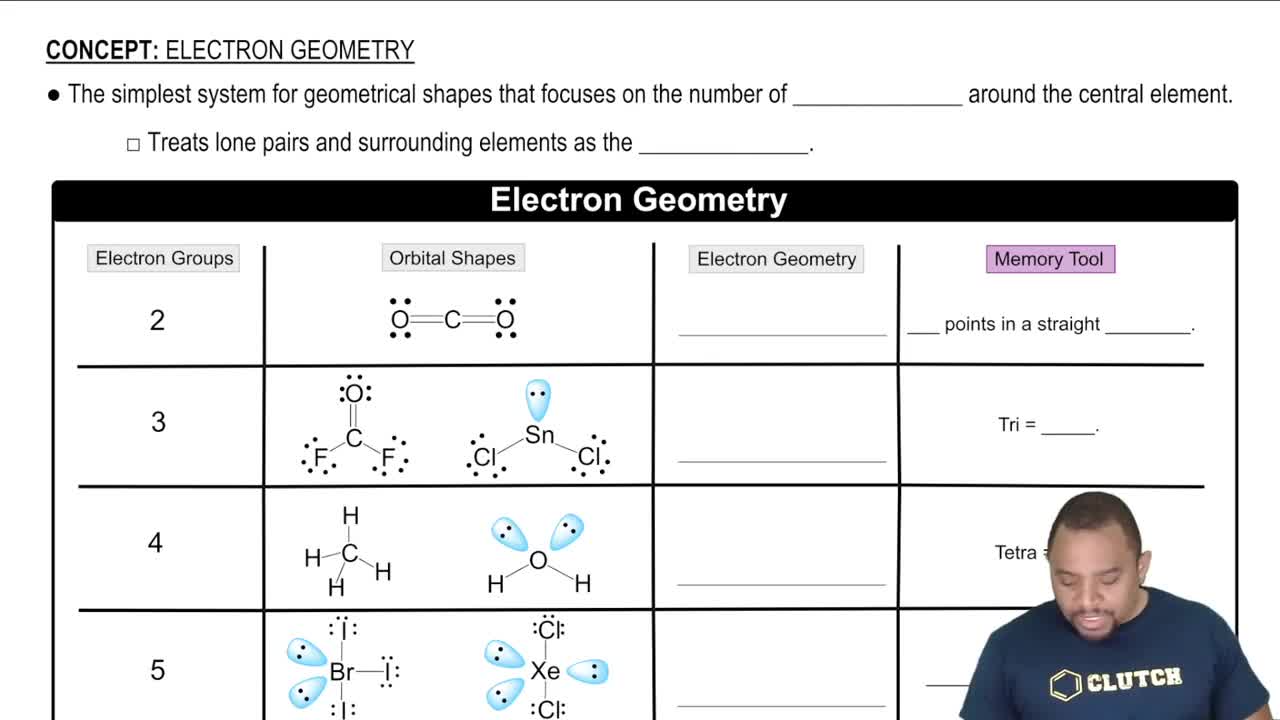
Electron-domain geometry refers to the spatial arrangement of electron domains around a central atom in a molecule. Electron domains can be lone pairs, single bonds, double bonds, or triple bonds. The geometry is determined by the number of these domains, which influences the overall shape of the molecule according to VSEPR (Valence Shell Electron Pair Repulsion) theory.
Video consigliato:
Percorso guidato
04:44
Electron Geometry

VSEPR Theory

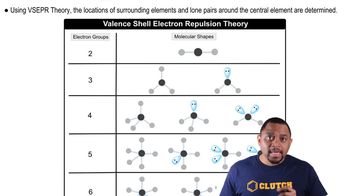
VSEPR theory is a model used to predict the geometry of individual molecules based on the repulsion between electron pairs in the valence shell of the central atom. According to this theory, electron pairs will arrange themselves as far apart as possible to minimize repulsion, leading to specific molecular shapes such as linear, trigonal planar, tetrahedral, and octahedral.
Video consigliato:
Percorso guidato
02:13
Molecular Shapes and VSEPR

Molecular Geometry of SF2, SF4, and SF6

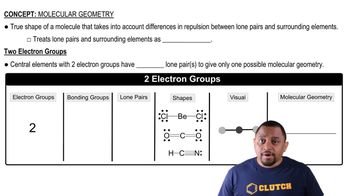
The molecular geometry of SF2, SF4, and SF6 can be predicted by applying VSEPR theory to the sulfur atom's electron domains. SF2 has two bonding pairs and two lone pairs, resulting in a bent shape. SF4 has four bonding pairs and one lone pair, leading to a seesaw shape. SF6, with six bonding pairs and no lone pairs, adopts an octahedral geometry.
Video consigliato:
Percorso guidato
01:33
Molecular Geometry with Two Electron Groups
Pratica correlata
Domanda del libro di testo

Sodium azide is a shock-sensitive compound that releases N2 upon physical impact. The compound is used in automobile airbags. The azide ion is N3-. (a) Draw the Lewis structure of the azide ion that minimizes formal charge (it does not form a triangle). Is it linear or bent?

537
views
Domanda del libro di testo

(b) The anion IO4- has a tetrahedral structure: three oxygen atoms form double bonds with the central iodine atom and one oxygen atom which carries a negative charge forms a single bond. Predict the molecular geometry of IO65-.

Domanda del libro di testo

An AB5 molecule adopts the geometry shown here. (c) Suppose the B atoms are halogen atoms. Of which group in the periodic table is atom A a member: (i) Group 15, (ii) Group 16, (iii) Group 17, (iv) Group 18, or (v) More information is needed?

618
views
Domanda del libro di testo

Which of the following statements about hybrid orbitals is or are true? (i) After an atom undergoes sp hybridization, there is one unhybridized p orbital on the atom, (ii) Under sp2 hybridization, the large lobes point to the vertices of an equilateral triangle, and (iii) The angle between the large lobes of sp3 hybrids is 109.5°.

1865
views
Domanda del libro di testo

The O¬H bond lengths in the water molecule 1H2O2 are 96 pm, and the H¬O¬H angle is 104.5°. The dipole moment of the water molecule is 1.85 D. (b) Calculate the magnitude of the bond dipole of the O¬H bonds. (Note: You will need to use vector addition to do this.)

2065
views
2
rank