Ethyl propanoate, CH3CH2COOCH2CH3, gives a fruity pineapple-like smell. (e) What are the approximate bond angles around each carbon atom in the molecule?
Ch.9 - Molecular Geometry and Bonding Theories
Brown14th EditionChemistry: The Central ScienceISBN: 9780134414232Non è quello che usi tu?Cambia libro di testo
Capitolo 9, Problema 93c
An AB5 molecule adopts the geometry shown here. (c) Suppose the B atoms are halogen atoms. Of which group in the periodic table is atom A a member: (i) Group 15, (ii) Group 16, (iii) Group 17, (iv) Group 18, or (v) More information is needed?

Guida verificata passo dopo passo1
Identify the geometry of the AB5 molecule. The image shows a trigonal bipyramidal geometry.
Determine the number of valence electrons for atom A. In a trigonal bipyramidal geometry, atom A must have 5 bonding pairs and no lone pairs.
Recall that halogen atoms (B) belong to Group 17 and each contributes 1 electron to the bond.
Calculate the total number of valence electrons needed for the AB5 molecule. Since there are 5 B atoms, each contributing 1 electron, atom A must provide 5 electrons.
Conclude that atom A must have 5 valence electrons, which corresponds to Group 15 in the periodic table.

Risposta video verificata per un problema simile:
Questa soluzione video è stata consigliata dai nostri tutor come utile per risolvere questo problema.
Durata del video:
1mConcetti chiave
Ecco i concetti essenziali che devi comprendere per rispondere correttamente alla domanda.
Molecular Geometry
Molecular geometry refers to the three-dimensional arrangement of atoms within a molecule. In the case of an AB5 molecule, the central atom A is surrounded by five B atoms, which typically leads to a trigonal bipyramidal geometry. Understanding molecular geometry is crucial for predicting the shape and reactivity of molecules, as it influences properties such as polarity and intermolecular interactions.
Video consigliato:
Percorso guidato
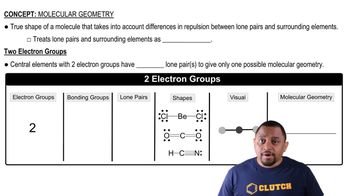
Molecular Geometry with Two Electron Groups
Periodic Table Groups
The periodic table is organized into groups, which are vertical columns that share similar chemical properties. Group 15 includes nitrogen and phosphorus, Group 16 includes oxygen and sulfur, Group 17 includes halogens like fluorine and chlorine, and Group 18 consists of noble gases such as helium and neon. Identifying the group of atom A is essential for understanding its chemical behavior and bonding characteristics with the halogen B atoms.
Video consigliato:
Percorso guidato
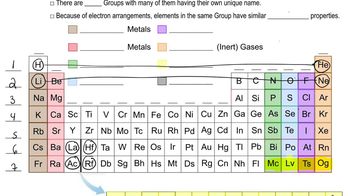
Periodic Table: Group Names
Valence Electrons and Bonding
Valence electrons are the outermost electrons of an atom and play a key role in chemical bonding. The number of valence electrons determines how an atom interacts with others, including the formation of covalent bonds. In the context of the AB5 molecule, knowing the valence electron configuration of atom A helps in predicting its ability to bond with five halogen atoms, which typically have seven valence electrons and form single covalent bonds.
Video consigliato:
Percorso guidato
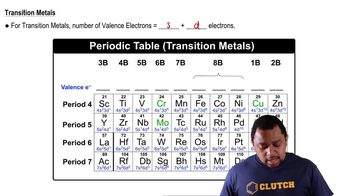
Transition Metals Valence Electrons
Pratica correlata
Domanda del libro di testo
2383
views
Domanda del libro di testo
a) Predict the electron-domain geometry around the central S atom in SF2, SF4, and SF6.
701
views
Domanda del libro di testo
The O¬H bond lengths in the water molecule 1H2O2 are 96 pm, and the H¬O¬H angle is 104.5°. The dipole moment of the water molecule is 1.85 D. (b) Calculate the magnitude of the bond dipole of the O¬H bonds. (Note: You will need to use vector addition to do this.)
2065
views
2
rank
Domanda del libro di testo
An AB5 molecule adopts the geometry shown here. (b) Do you think there are any nonbonding electron pairs on atom A?
652
views
Domanda del libro di testo
Ethyl propanoate, CH3CH2COOCH2CH3, gives a fruity pineapple-like smell. (a) Draw the Lewis structure for the molecule, assuming that carbon always forms four bonds in its stable compounds. (b) How many s and how many p bonds are in the molecule?
1
views