Ch.9 - Molecular Geometry and Bonding Theories
Brown - Chemistry: The Central Science 14th Edition
Brown14th EditionChemistry: The Central ScienceISBN: 9780134414232Non è quello che usi tu?Cambia libro di testo
Capitolo 9, Problema 71b

Consider the H2+ ion. (b) How many electrons are there in the H2+ ion?

Guida verificata passo dopo passo
1
Identify the composition of a neutral hydrogen molecule (H2). A neutral H2 molecule consists of two hydrogen atoms.
Recognize that each hydrogen atom in its neutral state has one electron. Therefore, a neutral H2 molecule has a total of two electrons.
Understand that the '+' sign in H2+ indicates the loss of one electron from the neutral H2 molecule.
Subtract one electron from the total number of electrons in the neutral H2 molecule to account for the positive charge in H2+.
Conclude that the H2+ ion, having lost one electron, contains one electron.

Risposta video verificata per un problema simile:

Questa soluzione video è stata consigliata dai nostri tutor come utile per risolvere questo problema.
Durata del video:
1m

Concetti chiave

Ecco i concetti essenziali che devi comprendere per rispondere correttamente alla domanda.

Molecular Ions

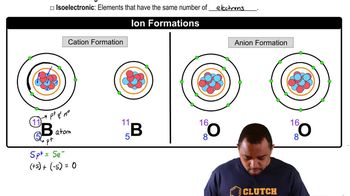
Molecular ions are charged species formed when molecules gain or lose electrons. In the case of H2+, the ion is formed from two hydrogen atoms (H) that share a pair of electrons, but one electron is removed, resulting in a positive charge. Understanding how molecular ions are formed is crucial for determining their electron count.
Video consigliato:

Electron Count in Ions

The electron count in an ion is determined by the number of electrons present in the neutral atom or molecule minus the number of electrons lost or plus the number gained. For H2+, which is derived from two neutral hydrogen atoms (each having one electron), the removal of one electron leads to a total of one electron remaining in the ion.
Video consigliato:

Atomic Structure of Hydrogen

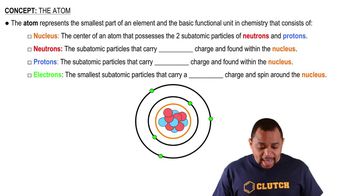
Hydrogen is the simplest element, consisting of one proton and one electron in its neutral state. When considering the H2+ ion, it is essential to recognize that each hydrogen atom contributes one electron, and the overall structure of the ion is influenced by the interactions between the two hydrogen nuclei and the remaining electron. This understanding aids in visualizing the ion's formation and electron configuration.
Video consigliato: