Ch.9 - Molecular Geometry and Bonding Theories
Brown - Chemistry: The Central Science 14th Edition
Brown14th EditionChemistry: The Central ScienceISBN: 9780134414232Non è quello che usi tu?Cambia libro di testo
Capitolo 9, Problema 70b

(b) If you combine two atomic orbitals on one atom to make a new orbital, is this a hybrid orbital or a molecular orbital?

Guida verificata passo dopo passo
1
Understand the concept of atomic orbitals: Atomic orbitals are regions in an atom where there is a high probability of finding electrons. They are described by quantum numbers and can be s, p, d, or f orbitals.
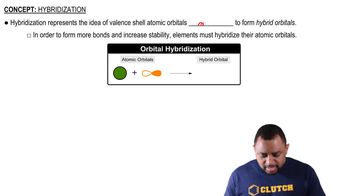
Learn about hybrid orbitals: Hybrid orbitals are formed when atomic orbitals on the same atom mix to form new orbitals. This process is called hybridization, and it typically occurs in covalent bonding to allow atoms to form more stable bonds.
Differentiate between hybrid orbitals and molecular orbitals: Hybrid orbitals are formed from atomic orbitals on the same atom, while molecular orbitals are formed from atomic orbitals on different atoms when they combine during the formation of a molecule.
Apply the concept to the problem: Since the problem involves combining two atomic orbitals on one atom, this process is related to hybridization, resulting in hybrid orbitals.
Conclude the explanation: The combination of two atomic orbitals on one atom to make a new orbital results in a hybrid orbital, not a molecular orbital.

Risposta video verificata per un problema simile:

Questa soluzione video è stata consigliata dai nostri tutor come utile per risolvere questo problema.
Durata del video:
1m

Concetti chiave

Ecco i concetti essenziali che devi comprendere per rispondere correttamente alla domanda.

Hybrid Orbitals

Hybrid orbitals are formed when atomic orbitals on the same atom combine to create new orbitals that are degenerate in energy and have different shapes. This process allows for the formation of bonds that are more effective in terms of geometry and energy, such as in sp, sp2, or sp3 hybridization. Hybridization is crucial for understanding molecular geometry and bonding in covalent compounds.
Video consigliato:

Molecular Orbitals

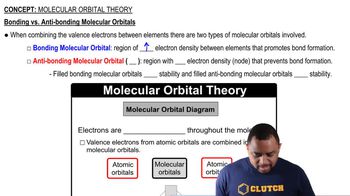
Molecular orbitals are formed when atomic orbitals from different atoms combine to create new orbitals that belong to the entire molecule rather than to individual atoms. This concept is central to molecular orbital theory, which explains the bonding and electronic structure of molecules. Molecular orbitals can be bonding, antibonding, or non-bonding, influencing the stability and reactivity of the molecule.
Video consigliato:
Percorso guidato
03:06
Molecular Orbital Theory

Atomic Orbitals

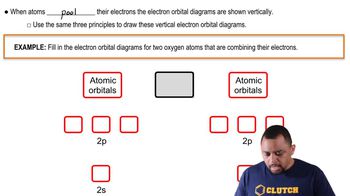
Atomic orbitals are regions in an atom where there is a high probability of finding electrons. They are defined by quantum numbers and include s, p, d, and f types, each with distinct shapes and energy levels. Understanding atomic orbitals is essential for grasping how they can combine to form hybrid or molecular orbitals, which are fundamental to chemical bonding.
Video consigliato:
Percorso guidato
01:51
Atomic Orbitals Example