Ch.9 - Molecular Geometry and Bonding Theories
Brown - Chemistry: The Central Science 14th Edition
Brown14th EditionChemistry: The Central ScienceISBN: 9780134414232Non è quello che usi tu?Cambia libro di testo
Capitolo 9, Problema 49c

Consider the molecule BF3. (c) What hybrid orbitals should be constructed on the B atom to make the B–F bonds in BF3?

Guida verificata passo dopo passo
1
Step 1: Identify the central atom in the molecule. In this case, the central atom is Boron (B).
Step 2: Determine the number of electron domains around the central atom. An electron domain is any area where electrons are most likely to be found, such as a single bond, double bond, triple bond, or a lone pair of electrons. In BF3, Boron forms single bonds with three Fluorine atoms, so there are three electron domains.
Step 3: Use the number of electron domains to determine the hybridization of the central atom. In this case, three electron domains correspond to sp2 hybridization.
Step 4: The sp2 hybridization means that one s orbital and two p orbitals on Boron are mixed to form three new sp2 hybrid orbitals.
Step 5: These sp2 hybrid orbitals are then used to form bonds with the Fluorine atoms in BF3.

Risposta video verificata per un problema simile:

Questa soluzione video è stata consigliata dai nostri tutor come utile per risolvere questo problema.
Durata del video:
43s

Concetti chiave

Ecco i concetti essenziali che devi comprendere per rispondere correttamente alla domanda.

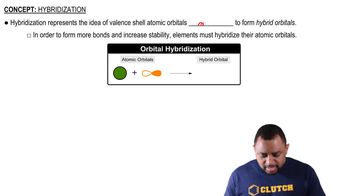
Hybridization

Hybridization is the process of combining atomic orbitals to form new hybrid orbitals that can accommodate bonding. In BF3, the boron atom undergoes sp2 hybridization, which involves mixing one s orbital and two p orbitals to create three equivalent sp2 hybrid orbitals. This allows boron to form three sigma bonds with fluorine atoms.
Video consigliato:

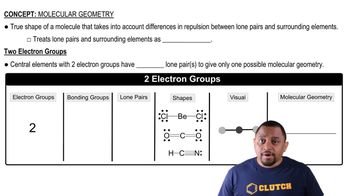
Molecular Geometry

Molecular geometry refers to the three-dimensional arrangement of atoms in a molecule. In the case of BF3, the sp2 hybridization leads to a trigonal planar geometry, where the three B–F bonds are arranged at 120-degree angles around the boron atom. Understanding molecular geometry is crucial for predicting the shape and reactivity of molecules.
Video consigliato:
Percorso guidato
01:33
Molecular Geometry with Two Electron Groups

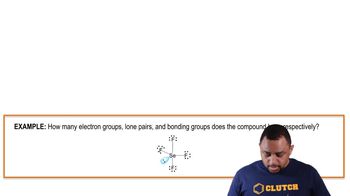
Bonding and Lone Pairs

In covalent bonding, atoms share electrons to achieve stability. In BF3, boron forms three bonds with fluorine atoms, utilizing its sp2 hybrid orbitals. Importantly, boron has an incomplete octet, as it does not have any lone pairs of electrons, which influences its reactivity and the overall electron deficiency of the molecule.
Video consigliato:
Percorso guidato
00:51
Electron Groups, Lone Pairs, and Bonding Groups Example