Ch.9 - Molecular Geometry and Bonding Theories
Brown - Chemistry: The Central Science 14th Edition
Brown14th EditionChemistry: The Central ScienceISBN: 9780134414232Non è quello che usi tu?Cambia libro di testo
Capitolo 9, Problema 48

How would you expect the extent of overlap of the bonding atomic orbitals to vary in the series IF, ICl, IBr, and I2? Explain your answer.

Guida verificata passo dopo passo
1
Identify the concept of atomic orbital overlap: The extent of overlap between atomic orbitals is crucial for bond strength. Greater overlap generally leads to stronger bonds.
Consider the size of the halogen atoms: As you move down the halogen group in the periodic table (F, Cl, Br, I), the atomic size increases.
Analyze the effect of atomic size on overlap: Larger atoms have more diffuse orbitals, which can lead to less effective overlap compared to smaller atoms.
Compare the pairs: In the series IF, ICl, IBr, and I2, the overlap is expected to be greatest in IF and least in I2, as fluorine is the smallest atom and iodine is the largest.
Conclude with the trend: The extent of overlap decreases as the size of the halogen atom bonded to iodine increases, leading to weaker bonds in the order IF > ICl > IBr > I2.

Risposta video verificata per un problema simile:

Questa soluzione video è stata consigliata dai nostri tutor come utile per risolvere questo problema.
Durata del video:
2m

Concetti chiave

Ecco i concetti essenziali che devi comprendere per rispondere correttamente alla domanda.

Atomic Orbitals

Atomic orbitals are regions in an atom where there is a high probability of finding electrons. They come in different shapes (s, p, d, f) and sizes, which influence how atoms bond with each other. The overlap of atomic orbitals between two atoms is crucial for the formation of covalent bonds, as greater overlap typically leads to stronger bonds.
Video consigliato:
Percorso guidato
01:51
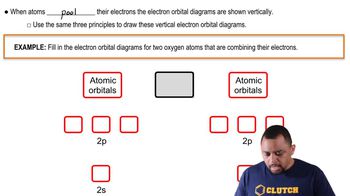
Atomic Orbitals Example

Bonding and Overlap

The extent of overlap between atomic orbitals is a key factor in determining the strength and stability of a covalent bond. When two atomic orbitals overlap significantly, they can share electrons more effectively, resulting in a stronger bond. In the context of the given compounds, the size and electronegativity of the atoms involved will affect how well their orbitals can overlap.
Video consigliato:

Electronegativity and Bonding Characteristics

Electronegativity is a measure of an atom's ability to attract and hold onto electrons. In the series IF, ICl, IBr, and I2, the differences in electronegativity between iodine and the other halogens (F, Cl, Br) will influence the nature of the bonds formed. Higher electronegativity differences can lead to more polar bonds, affecting the overlap of bonding orbitals and the overall bond strength.
Video consigliato:
Percorso guidato
02:10
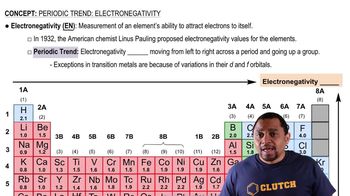
Electronegativity Trends