Ch.9 - Molecular Geometry and Bonding Theories
Brown - Chemistry: The Central Science 14th Edition
Brown14th EditionChemistry: The Central ScienceISBN: 9780134414232Non è quello che usi tu?Cambia libro di testo
Capitolo 9, Problema 76

Explain the following: (c) The O22 + ion has a stronger O—O bond than O2 itself.

Guida verificata passo dopo passo
1
Understand the electronic configuration of O2 and O2^2+: O2 has 16 electrons and is a diradical with two unpaired electrons in its molecular orbitals, which weakens the bond. O2^2+ (peroxide ion), having lost two electrons, results in 14 electrons with paired spins, leading to a more stable electronic configuration.
Recognize the bond order concept: Bond order is a measure of the number of chemical bonds between a pair of atoms. In molecular orbital theory, bond order is half the difference between the number of bonding and antibonding electrons. Higher bond order corresponds to a stronger bond.
Calculate the bond order for both O2 and O2^2+: For O2, the bond order is 2 (indicating a double bond), and for O2^2+, the bond order increases due to the loss of antibonding electrons, which strengthens the bond.
Relate bond strength to bond length: Generally, a higher bond order correlates with a shorter and stronger bond. Since O2^2+ has a higher bond order than O2, the O—O bond in O2^2+ is stronger and shorter than in O2.
Apply molecular orbital theory to explain stability: The removal of electrons from antibonding orbitals in O2^2+ leads to a reduction in electron-electron repulsion within the molecule, which contributes to the increased stability and strength of the O—O bond in O2^2+ compared to O2.

Risposta video verificata per un problema simile:

Questa soluzione video è stata consigliata dai nostri tutor come utile per risolvere questo problema.
Durata del video:
7m

Concetti chiave

Ecco i concetti essenziali che devi comprendere per rispondere correttamente alla domanda.

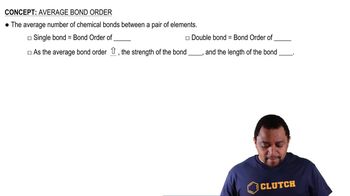
Bond Order

Bond order is a measure of the number of chemical bonds between a pair of atoms. It is calculated as the difference between the number of bonding and antibonding electrons divided by two. A higher bond order indicates a stronger bond, as seen in the O2 molecule, which has a bond order of 2, while the O22+ ion has a bond order of 3, suggesting a stronger O—O bond.
Video consigliato:
Percorso guidato
00:36
Average Bond Order

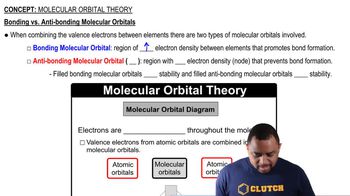
Molecular Orbital Theory

Molecular Orbital (MO) theory describes the electronic structure of molecules by considering the combination of atomic orbitals to form molecular orbitals. In the case of O2 and O22+, the removal of electrons from antibonding orbitals in O22+ leads to a greater stabilization of the bonding orbitals, resulting in a stronger O—O bond compared to the neutral O2 molecule.
Video consigliato:
Percorso guidato
03:06
Molecular Orbital Theory

Electron Configuration

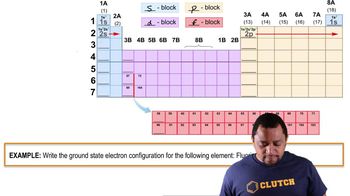
Electron configuration refers to the distribution of electrons in an atom or ion's orbitals. For O2, the electron configuration includes two unpaired electrons in antibonding orbitals, while O22+ has fewer electrons, leading to a more stable configuration. This reduction in electron repulsion in O22+ contributes to the increased strength of the O—O bond compared to O2.
Video consigliato:
Percorso guidato
01:33
Electron Configuration Example