Ch.9 - Molecular Geometry and Bonding Theories
Brown - Chemistry: The Central Science 14th Edition
Brown14th EditionChemistry: The Central ScienceISBN: 9780134414232Non è quello che usi tu?Cambia libro di testo
Capitolo 9, Problema 79d

Using Figures 9.35 and 9.43 as guides, draw the molecular orbital electron configuration for (d) Ne22 +. In each case indicate whether the addition of an electron to the ion would increase or decrease the bond order of the species.

Guida verificata passo dopo passo
1
Identify the total number of electrons in the neutral Ne2 molecule. Neon (Ne) has 10 electrons, so Ne2 has 20 electrons.
Since Ne2^2+ is given, remove 2 electrons from the total electron count of Ne2, resulting in 18 electrons for Ne2^2+.
Draw the molecular orbital (MO) diagram for Ne2^2+. Start by filling the molecular orbitals with the 18 electrons, following the order: \(\sigma_{1s}, \sigma_{1s}^*, \sigma_{2s}, \sigma_{2s}^*, \sigma_{2p_z}, \pi_{2p_x} = \pi_{2p_y}, \pi_{2p_x}^* = \pi_{2p_y}^*, \sigma_{2p_z}^*\).
Calculate the bond order using the formula: \(\text{Bond Order} = \frac{(\text{Number of bonding electrons} - \text{Number of antibonding electrons})}{2}\).
Consider the effect of adding an electron to Ne2^2+. Determine if the electron would enter a bonding or antibonding orbital and how this would affect the bond order.

Risposta video verificata per un problema simile:

Questa soluzione video è stata consigliata dai nostri tutor come utile per risolvere questo problema.
Durata del video:
3m

Concetti chiave

Ecco i concetti essenziali che devi comprendere per rispondere correttamente alla domanda.

Molecular Orbital Theory

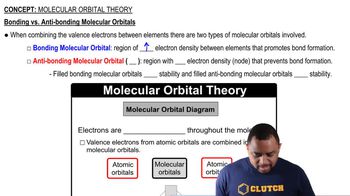
Molecular Orbital Theory describes how atomic orbitals combine to form molecular orbitals, which can be occupied by electrons. In this theory, electrons are delocalized over the entire molecule rather than being associated with individual atoms. Understanding this concept is crucial for determining the electron configuration of molecules and ions, as well as predicting their stability and bond order.
Video consigliato:
Percorso guidato
03:06
Molecular Orbital Theory

Bond Order

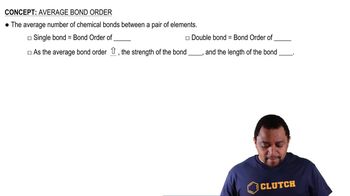
Bond order is a measure of the number of chemical bonds between a pair of atoms, calculated as the difference between the number of bonding and antibonding electrons divided by two. A higher bond order indicates a stronger bond and greater stability of the molecule. In the context of the question, determining how the addition of an electron affects bond order is essential for understanding the stability of the Ne22 + ion.
Video consigliato:
Percorso guidato
00:36
Average Bond Order

Electron Configuration

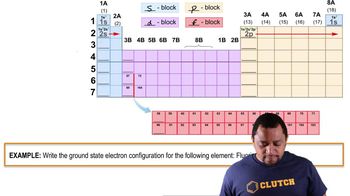
Electron configuration refers to the distribution of electrons in an atom or ion's molecular orbitals. It is represented by a series of numbers and letters that indicate the energy levels and types of orbitals occupied by electrons. For Ne22 +, accurately drawing the electron configuration is necessary to analyze how the addition of an electron influences the overall molecular stability and bond characteristics.
Video consigliato:
Percorso guidato
01:33
Electron Configuration Example