Ch.9 - Molecular Geometry and Bonding Theories
Brown - Chemistry: The Central Science 14th Edition
Brown14th EditionChemistry: The Central ScienceISBN: 9780134414232Non è quello che usi tu?Cambia libro di testo
Capitolo 9, Problema 22

How many electron domains are surrounding the central atoms which adopt the following geometries? (d) trigonal bipyramidal.

Guida verificata passo dopo passo
1
Identify the geometry mentioned in the problem, which is trigonal bipyramidal.
Understand that electron domains include lone pairs and bonds (single, double, or triple) around the central atom.
Recognize that in a trigonal bipyramidal geometry, there are no lone pairs on the central atom, and all electron domains are bonding pairs.
Count the positions in the trigonal bipyramidal structure: there are three equatorial positions and two axial positions.
Conclude that there are five electron domains (all bonding pairs) around the central atom in a trigonal bipyramidal geometry.

Risposta video verificata per un problema simile:

Questa soluzione video è stata consigliata dai nostri tutor come utile per risolvere questo problema.
Durata del video:
1m

Concetti chiave

Ecco i concetti essenziali che devi comprendere per rispondere correttamente alla domanda.

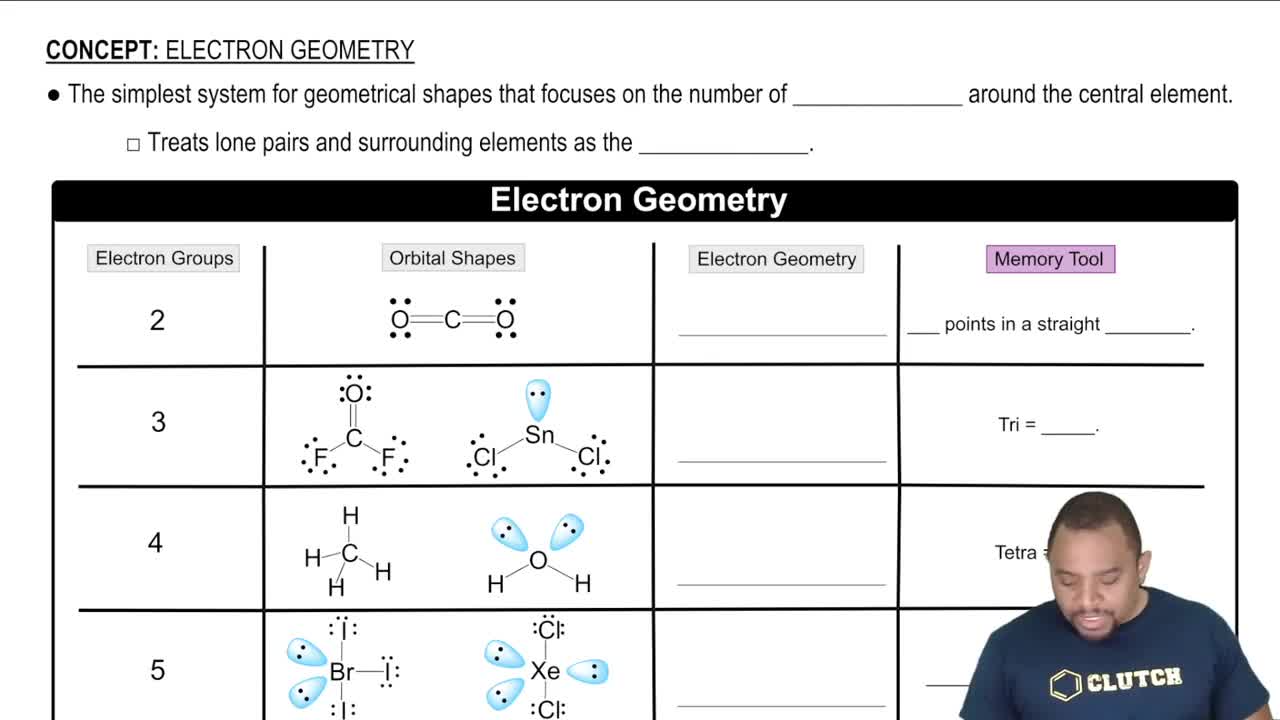
Electron Domains

Electron domains refer to regions around a central atom where electrons are likely to be found. These can include lone pairs, single bonds, double bonds, or triple bonds. The number of electron domains helps determine the molecular geometry of a compound, as each domain occupies space and influences the arrangement of other domains.
Video consigliato:
Percorso guidato
04:44
Electron Geometry

Trigonal Bipyramidal Geometry

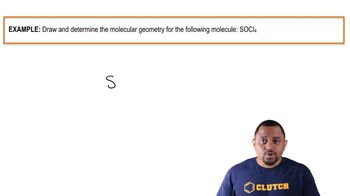
Trigonal bipyramidal geometry occurs when a central atom is surrounded by five electron domains. In this arrangement, three domains are positioned in a plane around the central atom, forming a triangle, while the other two are located above and below this plane. This geometry is characteristic of molecules with five bonding pairs and no lone pairs, such as phosphorus pentachloride (PCl5).
Video consigliato:
Percorso guidato
01:16
Trigonal Bipyramidal Example

VSEPR Theory

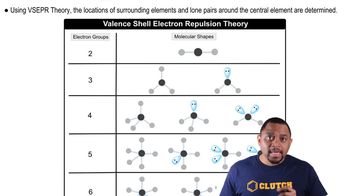
Valence Shell Electron Pair Repulsion (VSEPR) theory is a model used to predict the geometry of molecules based on the repulsion between electron pairs. According to VSEPR, electron domains will arrange themselves as far apart as possible to minimize repulsion, leading to specific molecular shapes. Understanding VSEPR is essential for determining the geometry associated with different numbers of electron domains.
Video consigliato:
Percorso guidato
02:13
Molecular Shapes and VSEPR