
Ch.9 - Molecular Geometry and Bonding Theories
Brown - Chemistry: The Central Science 14th Edition
Brown14th EditionChemistry: The Central ScienceISBN: 9780134414232Non è quello che usi tu?Cambia libro di testo
Capitolo 9, Problema 21b

How many nonbonding electron pairs are there in each of the following molecules: (b) HCN

Guida verificata passo dopo passo
1
Step 1: Draw the Lewis structure for the molecule. For HCN, the Lewis structure would be H-C≡N. This shows that hydrogen (H) is single-bonded to carbon (C), and carbon is triple-bonded to nitrogen (N).
Step 2: Determine the number of valence electrons for each atom. Hydrogen has 1, carbon has 4, and nitrogen has 5.
Step 3: Calculate the total number of electrons used in bonding. Each single bond uses 2 electrons, and each triple bond uses 6 electrons. So, for HCN, there are 2 electrons in the H-C bond and 6 electrons in the C≡N bond, totaling 8 electrons.
Step 4: Subtract the total number of bonding electrons from the total number of valence electrons. For HCN, this would be (1+4+5) - 8 = 2. These are the nonbonding electrons.
Step 5: Since each pair of electrons counts as one, divide the number of nonbonding electrons by 2 to get the number of nonbonding electron pairs. For HCN, this would be 2/2 = 1 nonbonding electron pair.

Risposta video verificata per un problema simile:

Questa soluzione video è stata consigliata dai nostri tutor come utile per risolvere questo problema.
Durata del video:
3m

Concetti chiave

Ecco i concetti essenziali che devi comprendere per rispondere correttamente alla domanda.

Lewis Structures

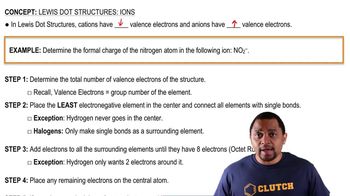
Lewis structures are diagrams that represent the bonding between atoms in a molecule and the lone pairs of electrons that may exist. They help visualize how many valence electrons are present and how they are distributed among the atoms. Understanding Lewis structures is essential for determining the number of nonbonding electron pairs in a molecule.
Video consigliato:
Percorso guidato
04:28
Lewis Dot Structures: Ions

Valence Electrons

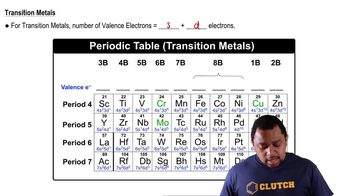
Valence electrons are the outermost electrons of an atom and are crucial for forming bonds with other atoms. The number of valence electrons determines how many bonds an atom can form and how many nonbonding pairs may exist. In the case of HCN, knowing the valence electrons of hydrogen, carbon, and nitrogen is key to identifying nonbonding pairs.
Video consigliato:
Percorso guidato
02:12
Transition Metals Valence Electrons

Molecular Geometry

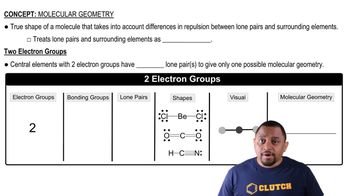
Molecular geometry refers to the three-dimensional arrangement of atoms in a molecule, which is influenced by the number of bonding and nonbonding electron pairs. The presence of nonbonding electron pairs can affect the shape and angles between bonds, impacting the overall structure of the molecule. Understanding molecular geometry is important for predicting the behavior and reactivity of molecules like HCN.
Video consigliato:
Percorso guidato
01:33
Molecular Geometry with Two Electron Groups