
Ch.9 - Molecular Geometry and Bonding Theories
Brown - Chemistry: The Central Science 14th Edition
Brown14th EditionChemistry: The Central ScienceISBN: 9780134414232Non è quello che usi tu?Cambia libro di testo
Capitolo 9, Problema 101

For one of the resonance forms of ozone, O3, which of the orbitals are used to make bonds and which are used to hold nonbonding pairs of electrons?

Guida verificata passo dopo passo
1
Identify the molecular structure of ozone (O3), which consists of three oxygen atoms arranged in a bent shape.
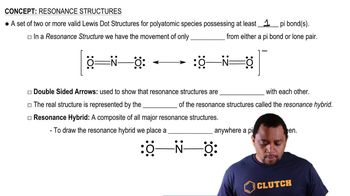
Recognize that ozone has resonance structures, meaning that the actual structure is a hybrid of multiple possible structures.
In one resonance form, consider the central oxygen atom forming a double bond with one of the terminal oxygen atoms and a single bond with the other terminal oxygen atom.
Determine that the sigma (σ) bonds are formed using sp2 hybrid orbitals on the central oxygen atom, while the pi (π) bond is formed using unhybridized p orbitals.
Identify that the nonbonding pairs of electrons (lone pairs) on the central oxygen atom are held in the remaining sp2 hybrid orbitals.

Concetti chiave

Ecco i concetti essenziali che devi comprendere per rispondere correttamente alla domanda.

Resonance Structures

Resonance structures are different ways of drawing the same molecule that illustrate the delocalization of electrons. In ozone (O3), resonance forms show how the double bond can shift between the oxygen atoms, affecting the distribution of electrons. Understanding resonance is crucial for predicting molecular behavior and stability.
Video consigliato:
Percorso guidato
01:42
Resonance Structures

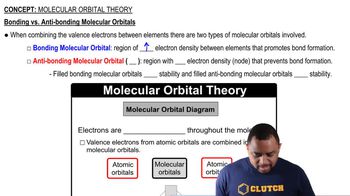
Molecular Orbitals

Molecular orbitals are formed by the combination of atomic orbitals when atoms bond together. In ozone, the bonding involves the overlap of p orbitals from the oxygen atoms, which create bonding and antibonding molecular orbitals. Recognizing which orbitals participate in bonding versus those that hold lone pairs is essential for understanding the molecule's structure.
Video consigliato:
Percorso guidato
03:06
Molecular Orbital Theory

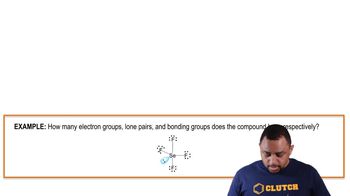
Lone Pairs and Bonding Pairs

Lone pairs are pairs of valence electrons that are not involved in bonding, while bonding pairs are shared between atoms to form covalent bonds. In ozone, certain p orbitals are occupied by lone pairs, influencing the molecule's geometry and reactivity. Identifying these pairs helps in visualizing the electron distribution and predicting molecular properties.
Video consigliato:
Percorso guidato
00:51
Electron Groups, Lone Pairs, and Bonding Groups Example
Pratica correlata
Domanda del libro di testo

Sodium azide is a shock-sensitive compound that releases N2 upon physical impact. The compound is used in automobile airbags. The azide ion is N3-. (a) Draw the Lewis structure of the azide ion that minimizes formal charge (it does not form a triangle). Is it linear or bent?

537
views
Domanda del libro di testo

Butadiene, C4H6, is a planar molecule that has the following carbon–carbon bond lengths:

(b) From left to right, what is the hybridization of each carbon atom in butadiene?

854
views
Domanda del libro di testo

Sodium azide is a shock-sensitive compound that releases N2 upon physical impact. The compound is used in automobile airbags. The azide ion is N3-. (b) State the hybridization of the central N atom in the azide ion.

720
views
Domanda del libro di testo

Butadiene, C4H6, is a planar molecule that has the following carbon–carbon bond lengths:

(a) Predict the bond angles around each of the carbon atoms and sketch the molecule.

1118
views
Domanda del libro di testo

In ozone, O3, the two oxygen atoms on the ends of the molecule are equivalent to one another. (d) How many electrons are delocalized in the p system of ozone?

1548
views
Domanda del libro di testo

Which of the following statements about hybrid orbitals is or are true? (i) After an atom undergoes sp hybridization, there is one unhybridized p orbital on the atom, (ii) Under sp2 hybridization, the large lobes point to the vertices of an equilateral triangle, and (iii) The angle between the large lobes of sp3 hybrids is 109.5°.

1865
views