
Ch.9 - Molecular Geometry and Bonding Theories
Brown - Chemistry: The Central Science 14th Edition
Brown14th EditionChemistry: The Central ScienceISBN: 9780134414232Non è quello che usi tu?Cambia libro di testo
Capitolo 9, Problema 101d

In ozone, O3, the two oxygen atoms on the ends of the molecule are equivalent to one another. (d) How many electrons are delocalized in the p system of ozone?

Guida verificata passo dopo passo
1
Step 1: Understand the structure of ozone. Ozone, O3, is a resonance hybrid of two Lewis structures where the central oxygen atom forms a single bond with one terminal oxygen atom and a double bond with the other. In the other resonance structure, these bond assignments are reversed. This means that the electrons in the double bond are not always between the same two oxygen atoms, but are delocalized over the whole molecule.
Step 2: Identify the delocalized electrons. In ozone, the delocalized electrons are the ones involved in the double bond. In each resonance structure, there is a double bond, which consists of one sigma bond and one pi bond. The pi bond is formed by the sideways overlap of p orbitals, and it is these pi electrons that are delocalized.
Step 3: Count the number of delocalized electrons. A pi bond consists of two electrons. Therefore, in the ozone molecule, there are two delocalized electrons in the pi system.

Risposta video verificata per un problema simile:

Questa soluzione video è stata consigliata dai nostri tutor come utile per risolvere questo problema.
Durata del video:
3m

Concetti chiave

Ecco i concetti essenziali che devi comprendere per rispondere correttamente alla domanda.

Delocalized Electrons

Delocalized electrons are electrons that are not associated with a single atom or a single bond but are spread over several atoms. In molecules like ozone (O3), these electrons contribute to resonance structures, allowing for a more stable configuration. This delocalization is crucial for understanding the molecule's reactivity and stability.
Video consigliato:
Percorso guidato
04:44
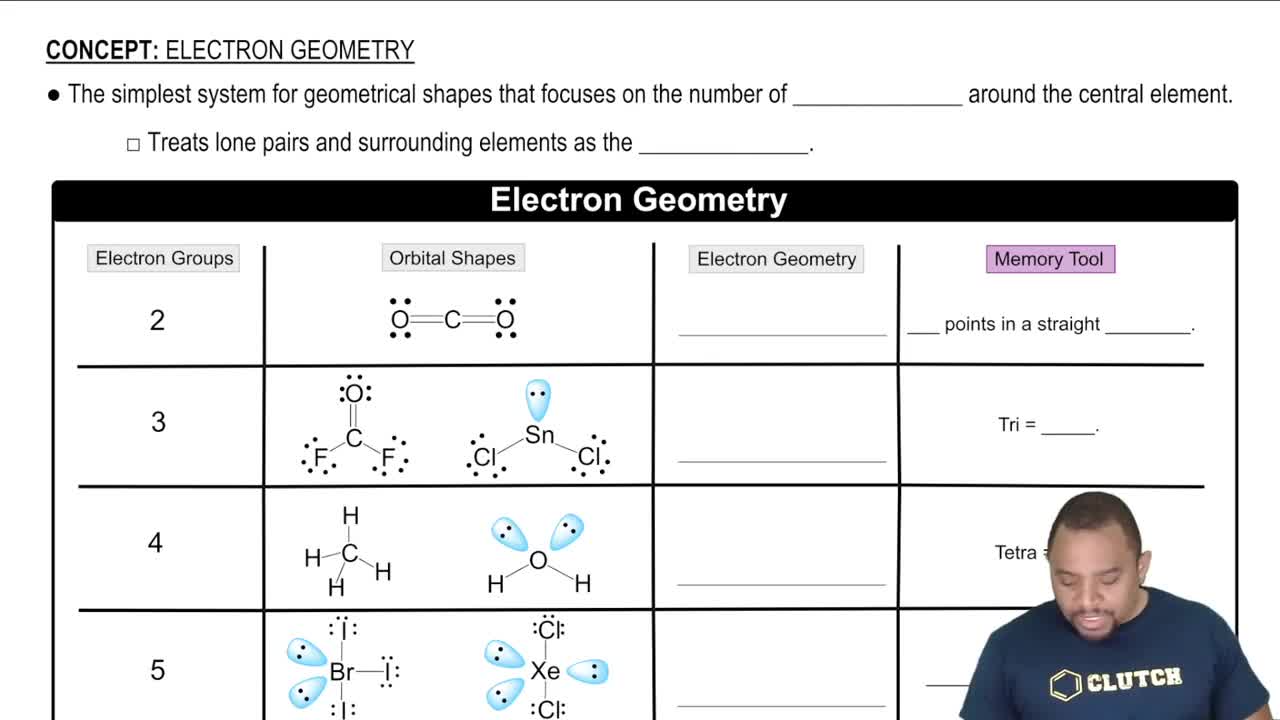
Electron Geometry

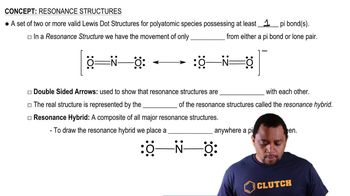
Resonance Structures

Resonance structures are different ways of drawing a molecule that cannot be accurately represented by a single Lewis structure. In ozone, resonance illustrates how the double bond between oxygen atoms can shift, leading to equivalent structures. This concept helps explain the delocalization of electrons and the overall stability of the molecule.
Video consigliato:
Percorso guidato
01:42
Resonance Structures

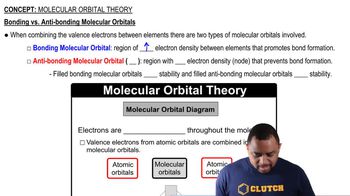
Molecular Orbital Theory

Molecular Orbital Theory describes how atomic orbitals combine to form molecular orbitals, which can be occupied by electrons. In ozone, the p orbitals of the oxygen atoms combine to create bonding and antibonding molecular orbitals, allowing for the delocalization of electrons across the molecule. This theory provides a deeper understanding of the electronic structure and properties of ozone.
Video consigliato:
Percorso guidato
03:06
Molecular Orbital Theory