Ch.9 - Molecular Geometry and Bonding Theories
Brown - Chemistry: The Central Science 14th Edition
Brown14th EditionChemistry: The Central ScienceISBN: 9780134414232Non è quello che usi tu?Cambia libro di testo
Capitolo 9, Problema 65b

In the sulphate ion, SO42-, the sulphur atom is the central atom with the other 4 oxygen atoms attached to it. (b) What hybridization is exhibited by the S atom?

Guida verificata passo dopo passo
1
Identify the number of electron groups around the central sulfur atom in the sulfate ion (SO42-). Each oxygen atom forms a bond with sulfur, and there are no lone pairs on sulfur in this ion.
Count the total number of electron groups around the sulfur atom. In the sulfate ion, there are four oxygen atoms bonded to sulfur, which means there are four electron groups.
Determine the hybridization based on the number of electron groups. For four electron groups, the hybridization is typically sp3.
Explain that sp3 hybridization involves the mixing of one s orbital and three p orbitals to form four equivalent sp3 hybrid orbitals.
Conclude that the sulfur atom in the sulfate ion exhibits sp3 hybridization, allowing it to form four sigma bonds with the oxygen atoms.

Risposta video verificata per un problema simile:

Questa soluzione video è stata consigliata dai nostri tutor come utile per risolvere questo problema.
Durata del video:
1m

Concetti chiave

Ecco i concetti essenziali che devi comprendere per rispondere correttamente alla domanda.

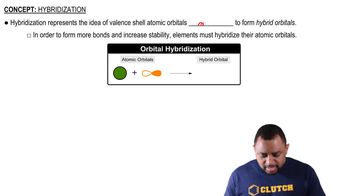
Hybridization

Hybridization is a concept in chemistry that describes the mixing of atomic orbitals to form new hybrid orbitals. These hybrid orbitals are used to explain the geometry and bonding properties of molecules. In the case of the sulphate ion, understanding hybridization helps determine the arrangement of the surrounding atoms and the bond angles.
Video consigliato:

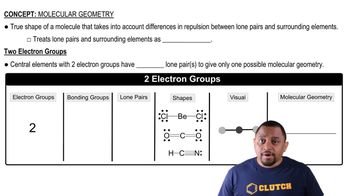
Molecular Geometry

Molecular geometry refers to the three-dimensional arrangement of atoms within a molecule. It is influenced by the number of bonding pairs and lone pairs of electrons around the central atom. For the sulphate ion, the tetrahedral geometry is crucial for understanding how the sulphur atom interacts with the four oxygen atoms.
Video consigliato:
Percorso guidato
01:33
Molecular Geometry with Two Electron Groups

Valence Shell Electron Pair Repulsion (VSEPR) Theory

VSEPR theory is a model used to predict the shape of molecules based on the repulsion between electron pairs in the valence shell of the central atom. It posits that electron pairs will arrange themselves to minimize repulsion, leading to specific molecular geometries. This theory is essential for determining the hybridization and shape of the sulphate ion.
Video consigliato:
Percorso guidato
00:47
Valence Shell Electron Pair Repulsion Theory