(c) Would you expect N2O to exhibit delocalized p bonding?
Ch.9 - Molecular Geometry and Bonding Theories
Brown14th EditionChemistry: The Central ScienceISBN: 9780134414232Non è quello che usi tu?Cambia libro di testo
Capitolo 9, Problema 65d
In the formate ion, HCO2-, the carbon atom is the central atom with the other three atoms attached to it. (d) How many electrons are in the p system of the ion?
Guida verificata passo dopo passo1
Step 1: Identify the atoms involved in the formate ion, HCO2-. The ion consists of one hydrogen (H), one carbon (C), and two oxygen (O) atoms.
Step 2: Determine the total number of valence electrons in the formate ion. Carbon has 4 valence electrons, each oxygen has 6 valence electrons, and hydrogen has 1 valence electron. Additionally, the negative charge indicates an extra electron.
Step 3: Draw the Lewis structure for the formate ion. Place carbon in the center, with the two oxygen atoms and one hydrogen atom bonded to it. Distribute the electrons to satisfy the octet rule for carbon and oxygen, and the duet rule for hydrogen.
Step 4: Identify the pi bonds in the structure. Pi bonds are formed from the side-to-side overlap of p orbitals. In the formate ion, look for double bonds between carbon and oxygen, which contain one sigma bond and one pi bond.
Step 5: Count the electrons in the pi system. Each pi bond contributes two electrons to the pi system. Sum the electrons from all pi bonds to find the total number of electrons in the p system of the ion.

Risposta video verificata per un problema simile:
Questa soluzione video è stata consigliata dai nostri tutor come utile per risolvere questo problema.
Durata del video:
6mConcetti chiave
Ecco i concetti essenziali che devi comprendere per rispondere correttamente alla domanda.
Valence Electrons
Valence electrons are the outermost electrons of an atom and are crucial for understanding chemical bonding and molecular structure. In the case of the formate ion (HCO2-), the carbon atom has four valence electrons, while the oxygen atoms contribute additional electrons, and the hydrogen atom contributes one. The total number of valence electrons determines how the atoms bond and the overall charge of the ion.
Video consigliato:
Percorso guidato
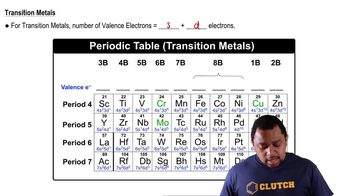
Transition Metals Valence Electrons
Molecular Geometry
Molecular geometry refers to the three-dimensional arrangement of atoms within a molecule. In the formate ion, the carbon atom is central, and the arrangement of the hydrogen and oxygen atoms around it affects the ion's shape and properties. Understanding molecular geometry is essential for predicting the behavior of the ion in chemical reactions and interactions.
Video consigliato:
Percorso guidato
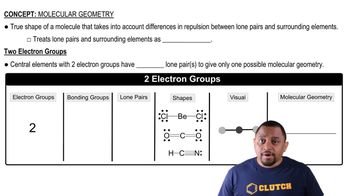
Molecular Geometry with Two Electron Groups
p System Electrons
The p system refers to the electrons in the p orbitals of an atom, which can participate in bonding and resonance structures. In the formate ion, the p orbitals of the oxygen atoms are involved in forming double bonds with carbon, contributing to the resonance stabilization of the ion. Counting the p system electrons is important for understanding the ion's electronic structure and reactivity.
Video consigliato:
Percorso guidato
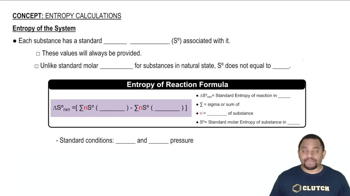
Entropy of the System
Pratica correlata
Domanda del libro di testo
475
views
Domanda del libro di testo
In the formate ion, HCO2-, the carbon atom is the central atom with the other three atoms attached to it. (c) Are there multiple equivalent resonance structures for the ion?
1366
views
Domanda del libro di testo
Consider the Lewis structure shown below.
(a) Does the Lewis structure depict a neutral molecule or an ion? If it is an ion, what is the charge on the ion? What is the charge on the ion
625
views
Domanda del libro di testo
Predict the molecular geometry of each of the following molecules: (b) H O C O C O O H
650
views
Domanda del libro di testo
In the sulphate ion, SO42-, the sulphur atom is the central atom with the other 4 oxygen atoms attached to it. (b) What hybridization is exhibited by the S atom?
Domanda del libro di testo
What hybridization do you expect for the atom that is underlined in each of the following species? (a) IO2- (b) NH4+ (c) SCN- (d) BrCl3
574
views