Predict whether each of the following molecules is polar or nonpolar: (a) IF, (b) CS2, (c) SO3, (d) PCl3, (e) SF6, (f) IF5.
Ch.9 - Molecular Geometry and Bonding Theories
Brown14th EditionChemistry: The Central ScienceISBN: 9780134414232Non è quello che usi tu?Cambia libro di testo
Capitolo 9, Problema 42
Predict whether each of the following molecules is polar or nonpolar: (a) CCl4, (b) NH3, (c) SF4, (d) XeF4, (e) CH3Br, (f) GaH3.
Guida verificata passo dopo passo1
1. To determine whether a molecule is polar or nonpolar, we first need to understand the concept of polarity. A molecule is polar if it has a net dipole moment. This happens when there is an imbalance in the electron distribution around the molecule, usually due to differences in electronegativity between the atoms.
2. For molecule (a) CCl4, look at the Lewis structure and molecular geometry. CCl4 has a tetrahedral shape with the carbon atom in the center and the four chlorine atoms surrounding it. The electronegativity difference between carbon and chlorine does create individual bond dipoles, but because of the symmetrical arrangement of these bonds, the dipoles cancel each other out, resulting in a nonpolar molecule.
3. For molecule (b) NH3, the nitrogen atom is in the center with three hydrogen atoms and one lone pair of electrons. The molecule has a trigonal pyramidal shape. The electronegativity difference between nitrogen and hydrogen creates a dipole, and because of the asymmetrical shape, these dipoles do not cancel out. Therefore, NH3 is a polar molecule.
4. For molecule (c) SF4, the sulfur atom is in the center with four fluorine atoms and one lone pair of electrons. The molecule has a see-saw shape. The electronegativity difference between sulfur and fluorine creates a dipole, and because of the asymmetrical shape, these dipoles do not cancel out. Therefore, SF4 is a polar molecule.
5. Repeat the same process for the remaining molecules (d) XeF4, (e) CH3Br, and (f) GaH3. Look at their Lewis structures, molecular geometries, and electronegativity differences to determine if they are polar or nonpolar.

Risposta video verificata per un problema simile:
Questa soluzione video è stata consigliata dai nostri tutor come utile per risolvere questo problema.
Durata del video:
8mConcetti chiave
Ecco i concetti essenziali che devi comprendere per rispondere correttamente alla domanda.
Molecular Geometry
Molecular geometry refers to the three-dimensional arrangement of atoms within a molecule. The shape of a molecule significantly influences its polarity, as it determines how the dipole moments of individual bonds combine. For example, symmetrical shapes like tetrahedral or square planar can lead to nonpolar molecules, while asymmetrical shapes often result in polar molecules.
Video consigliato:
Percorso guidato
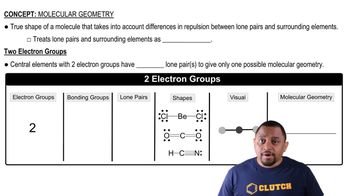
Molecular Geometry with Two Electron Groups
Electronegativity
Electronegativity is a measure of an atom's ability to attract and hold onto electrons in a chemical bond. Differences in electronegativity between bonded atoms create dipole moments, where one end of the bond becomes partially negative and the other partially positive. This concept is crucial for determining the polarity of a molecule, as polar bonds contribute to an overall molecular dipole if the geometry is asymmetrical.
Video consigliato:
Percorso guidato
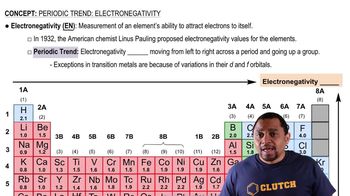
Electronegativity Trends
Dipole Moment
A dipole moment is a vector quantity that represents the separation of positive and negative charges in a molecule. It is calculated as the product of the charge and the distance between the charges. Molecules with a net dipole moment are considered polar, while those with no net dipole moment are nonpolar. Understanding dipole moments helps predict the behavior of molecules in electric fields and their interactions with other substances.
Video consigliato:
Percorso guidato
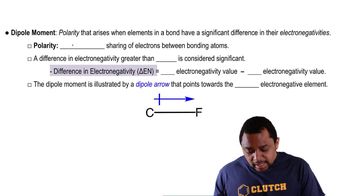
Dipole Moment
Pratica correlata
Domanda del libro di testo
1680
views
Domanda del libro di testo
(a) Consider the following two molecules: PCl3 and BCl3. Which molecule has a nonzero dipole moment?
877
views
Domanda del libro di testo
Dichloroethylene (C2H2Cl2) has three forms (isomers), each of which is a different substance. (b) Which of these isomers has a zero dipole moment?
591
views
Domanda del libro di testo
(c) Does the molecule BF2Cl have a dipole moment?
1411
views
Domanda del libro di testo
Dihydroxybenzene, C6H6O2, exists in three forms (isomers) called ortho, meta, and para:
Which of these has a nonzero dipole moment?
812
views
Domanda del libro di testo
Dichloroethylene (C2H2Cl2) has three forms (isomers), each of which is a different substance. (c) How many isomeric forms can chloroethylene, C2H3Cl, have? Would they be expected to have dipole moments?
2
views