Ch.9 - Molecular Geometry and Bonding Theories
Brown - Chemistry: The Central Science 14th Edition
Brown14th EditionChemistry: The Central ScienceISBN: 9780134414232Non è quello che usi tu?Cambia libro di testo
Capitolo 9, Problema 41

Predict whether each of the following molecules is polar or nonpolar: (a) IF, (b) CS2, (c) SO3, (d) PCl3, (e) SF6, (f) IF5.

Guida verificata passo dopo passo
1
Determine the molecular geometry for each molecule using VSEPR theory.
Assess the electronegativity difference between the atoms in each molecule to identify polar bonds.
For each molecule, evaluate the symmetry of the molecular geometry to determine if the dipoles cancel out.
If the dipoles do not cancel out, the molecule is polar; if they do, the molecule is nonpolar.
Summarize the polarity of each molecule based on the analysis of bond polarity and molecular geometry.

Risposta video verificata per un problema simile:

Questa soluzione video è stata consigliata dai nostri tutor come utile per risolvere questo problema.
Durata del video:
2m

Concetti chiave

Ecco i concetti essenziali che devi comprendere per rispondere correttamente alla domanda.

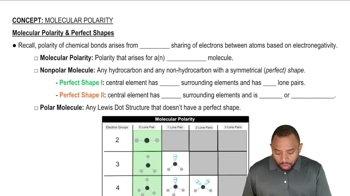
Molecular Polarity

Molecular polarity refers to the distribution of electrical charge across a molecule, which determines whether it has a positive or negative end. A molecule is polar if it has a significant difference in electronegativity between its atoms, leading to an uneven distribution of charge. Nonpolar molecules, on the other hand, have an even distribution of charge, often due to symmetrical arrangements of identical atoms or balanced dipoles.
Video consigliato:
Percorso guidato
02:38
Molecular Polarity

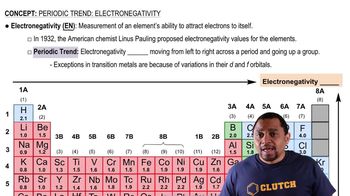
Electronegativity

Electronegativity is a measure of an atom's ability to attract and hold onto electrons in a chemical bond. The difference in electronegativity between two bonded atoms can indicate whether the bond is ionic, polar covalent, or nonpolar covalent. In general, larger differences in electronegativity (greater than 1.7) result in ionic bonds, while smaller differences (less than 1.7) can lead to polar or nonpolar covalent bonds.
Video consigliato:
Percorso guidato
02:10
Electronegativity Trends

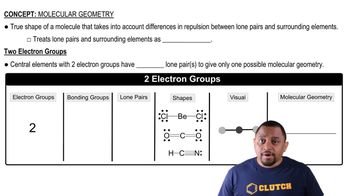
Molecular Geometry

Molecular geometry refers to the three-dimensional arrangement of atoms within a molecule. The shape of a molecule affects its polarity; for example, a symmetrical shape can lead to nonpolar characteristics even if the individual bonds are polar. Understanding the geometry, often predicted by VSEPR theory, is crucial for determining the overall polarity of a molecule, as it influences how dipoles from polar bonds interact.
Video consigliato:
Percorso guidato
01:33
Molecular Geometry with Two Electron Groups