Ch.1 - Introduction: Matter, Energy, and Measurement
Brown - Chemistry: The Central Science 15th Edition
Brown15th EditionChemistry: The Central ScienceISBN: 9780137542970Non è quello che usi tu?Cambia libro di testo
Capitolo 1, Problema 16d

Classify each of the following as a pure substance or a mixture. If a mixture, indicate whether it is homogeneous or heterogeneous: (d) sawdust.

Guida verificata passo dopo passo
1
Identify the composition of sawdust: Sawdust is composed of tiny particles of wood, which itself is a natural substance made up of cellulose, lignin, and other organic compounds.
Determine if sawdust is a pure substance or a mixture: A pure substance has a uniform and definite composition. Since wood (and thus sawdust) contains various organic compounds and possibly small amounts of other materials depending on its source, it does not have a uniform composition.
Assess the uniformity of the composition: Sawdust can contain different types of wood particles and possibly other contaminants like bark, dust, or soil, which are not uniformly distributed.
Classify sawdust based on its uniformity: Due to the non-uniform distribution of its components, sawdust is classified as a mixture.
Determine the type of mixture: Since the components of sawdust (different types of wood particles and other contaminants) are not uniformly distributed and can be visually distinguished, it is classified as a heterogeneous mixture.

Risposta video verificata per un problema simile:

Questa soluzione video è stata consigliata dai nostri tutor come utile per risolvere questo problema.
Durata del video:
4m

Concetti chiave

Ecco i concetti essenziali che devi comprendere per rispondere correttamente alla domanda.

Pure Substances

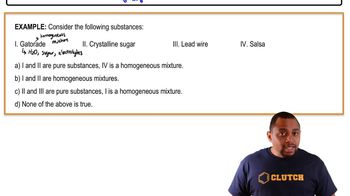
A pure substance consists of a single type of particle and has a uniform composition throughout. Examples include elements like oxygen and compounds like water. Pure substances have distinct physical and chemical properties that do not change regardless of the sample size.
Video consigliato:
Percorso guidato
02:58
Classification of Matter Example

Mixtures

Mixtures are combinations of two or more substances that retain their individual properties. They can be classified as homogeneous, where the composition is uniform (like saltwater), or heterogeneous, where the composition is not uniform (like a salad). The components in a mixture can often be separated by physical means.
Video consigliato:
Percorso guidato
01:03
Solubility and Mixtures

Homogeneous vs. Heterogeneous Mixtures

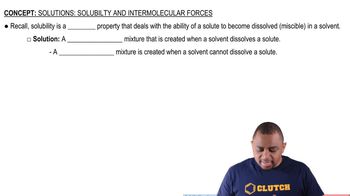
Homogeneous mixtures have a consistent composition throughout, making it difficult to distinguish the individual components, while heterogeneous mixtures contain visibly different substances or phases. For example, a solution of sugar in water is homogeneous, whereas a mixture of sand and iron filings is heterogeneous, as the individual components can be seen and separated.
Video consigliato:
Percorso guidato
01:03
Solubility and Mixtures