Classify each of the following as a pure substance or a mixture. If a mixture, indicate whether it is homogeneous or heterogeneous: (d) sawdust.
Ch.1 - Introduction: Matter, Energy, and Measurement

Brown15th EditionChemistry: The Central ScienceISBN: 9780137542970Non è quello che usi tu?Cambia libro di testo
Tutti i libri di testo
Brown 15th Edition
Ch.1 - Introduction: Matter, Energy, and Measurement
Problema 16b
Brown 15th Edition
Ch.1 - Introduction: Matter, Energy, and Measurement
Problema 16bCapitolo 1, Problema 16b
Classify each of the following as a pure substance or a mixture. If a mixture, indicate whether it is homogeneous or heterogeneous: (b) sugar crystals
Guida verificata passo dopo passo1
Identify the nature of sugar crystals: Sugar crystals are composed of molecules of sucrose, which is a disaccharide made from glucose and fructose.
Determine if sugar crystals consist of only one type of molecule or multiple types: Sugar crystals are made up entirely of sucrose molecules, with no other substances mixed in.
Assess the uniformity of the composition: Since sugar crystals consist solely of sucrose molecules, their composition is uniform throughout.
Classify based on the uniformity and composition: Because sugar crystals are made up of only one type of molecule and have a uniform composition, they are classified as a pure substance.
Conclude the classification: Sugar crystals are a pure substance, not a mixture.

Risposta video verificata per un problema simile:
Questa soluzione video è stata consigliata dai nostri tutor come utile per risolvere questo problema.
Durata del video:
2mConcetti chiave
Ecco i concetti essenziali che devi comprendere per rispondere correttamente alla domanda.
Pure Substances
A pure substance consists of a single type of particle and has a uniform composition throughout. Examples include elements like gold and compounds like water. Pure substances have distinct physical and chemical properties that do not change regardless of the sample size.
Video consigliato:
Percorso guidato
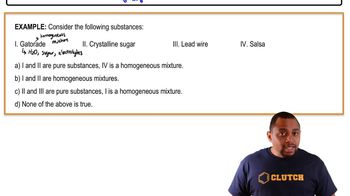
Classification of Matter Example
Mixtures
Mixtures are combinations of two or more substances that retain their individual properties. They can be classified as homogeneous, where the components are evenly distributed (like saltwater), or heterogeneous, where the components are not uniformly distributed (like a salad).
Video consigliato:
Percorso guidato
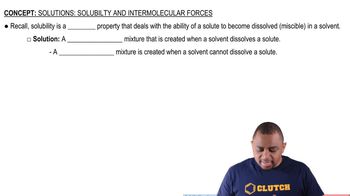
Solubility and Mixtures
Homogeneous vs. Heterogeneous Mixtures
Homogeneous mixtures have a consistent composition throughout, making it difficult to distinguish the individual components. In contrast, heterogeneous mixtures contain visibly different substances or phases, allowing for easy identification of the separate components. Understanding this distinction is crucial for classifying mixtures correctly.
Video consigliato:
Percorso guidato
Solubility and Mixtures
Pratica correlata
Domanda del libro di testo
2
views
Domanda del libro di testo
Classify each of the following as a pure substance or a mixture. If a mixture, indicate whether it is homogeneous or heterogeneous: (c) a hardboiled egg
3
views
Domanda del libro di testo
Classify each of the following as a pure substance or a mixture. If a mixture, indicate whether it is homogeneous or heterogeneous: c. magnesium
3
views
Domanda del libro di testo
Give the chemical symbol or name for the following elements, as appropriate: c. potassium
3
views
Domanda del libro di testo
Classify each of the following as a pure substance or a mixture. If a mixture, indicate whether it is homogeneous or heterogeneous: a. gasoline vapor,
2
views
Domanda del libro di testo
Classify each of the following as a pure substance or a mixture. If a mixture, indicate whether it is homogeneous or heterogeneous: d. crushed ice.
2
views