Ch.1 - Introduction: Matter, Energy, and Measurement
Brown - Chemistry: The Central Science 15th Edition
Brown15th EditionChemistry: The Central ScienceISBN: 9780137542970Non è quello che usi tu?Cambia libro di testo
Capitolo 1, Problema 74f

What type of quantity (for example, length, volume, density) do the following units indicate? f. nm

Guida verificata passo dopo passo
1
Identify the unit 'nm'.
Recognize that 'nm' stands for nanometer.
Understand that a nanometer is a unit of length in the metric system.
Recall that 1 nanometer is equal to 10^{-9} meters.
Conclude that 'nm' indicates a measurement of length.

Risposta video verificata per un problema simile:

Questa soluzione video è stata consigliata dai nostri tutor come utile per risolvere questo problema.
Durata del video:
33s

Concetti chiave

Ecco i concetti essenziali che devi comprendere per rispondere correttamente alla domanda.

Units of Measurement

Units of measurement are standardized quantities used to express physical properties. They provide a way to quantify and compare different attributes, such as length, volume, or mass. Understanding the specific units associated with a property is crucial for accurate scientific communication and calculations.
Video consigliato:
Percorso guidato
02:52
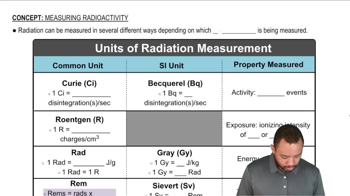
Units of Radiation Measurement

Nanometer (nm)

A nanometer (nm) is a unit of length in the metric system, equal to one billionth of a meter (10^-9 meters). It is commonly used in fields such as physics, chemistry, and biology to measure extremely small distances, such as atomic and molecular scales. Recognizing that nm is a measure of length is essential for interpreting measurements in nanotechnology and materials science.
Video consigliato:
Percorso guidato
01:48
Calculate Frequency Example

Dimensional Analysis

Dimensional analysis is a mathematical technique used to convert between different units of measurement and to check the consistency of equations. By analyzing the dimensions of physical quantities, one can determine the relationships between them and ensure that calculations yield results in the correct units. This concept is vital for understanding how to interpret and manipulate various units in scientific contexts.
Video consigliato:
Percorso guidato
06:11
Dimensional Analysis
Pratica correlata
Domanda del libro di testo

What type of quantity (for example, length, volume, density) do the following units indicate? g. K

2
views

Domanda del libro di testo

What type of quantity (for example, length, volume, density) do the following units indicate? a. mL

2
views
Domanda del libro di testo

Two students determine the percentage of iron in a sample as a laboratory exercise. The true percentage is 34.43%. The students’ results for three determinations are as follows: 1. 34.44, 34.41, 34.46 2. 34.51, 34.56, 34.48 b. Precision can be judged by examining the average of the deviations from the average value for that data set. (Calculate the average value for each data set; then calculate the average value of the absolute deviations of each measurement from the average.) Which set is more precise?

2
views
Domanda del libro di testo

Give the derived SI units for each of the following quantities in base SI units: (a) acceleration = distance/time2 (b) force = mass × acceleration (c) work = force × distance (d) pressure = force/area

458
views
Domanda del libro di testo

Give the derived SI units for each of the following quantities in base SI units: (e) power = work/time

1141
views
Domanda del libro di testo

A sample of ascorbic acid (vitamin C) is synthesized in the laboratory. It contains 1.50 g of carbon and 2.00 g of oxygen. Another sample of ascorbic acid isolated from citrus fruits contains 6.35 g of carbon. According to the law of constant composition, how many grams of oxygen does it contain?

2284
views