Ch.1 - Introduction: Matter, Energy, and Measurement
Brown - Chemistry: The Central Science 15th Edition
Brown15th EditionChemistry: The Central ScienceISBN: 9780137542970Non è quello che usi tu?Cambia libro di testo
Capitolo 1, Problema 71

A sample of ascorbic acid (vitamin C) is synthesized in the laboratory. It contains 1.50 g of carbon and 2.00 g of oxygen. Another sample of ascorbic acid isolated from citrus fruits contains 6.35 g of carbon. According to the law of constant composition, how many grams of oxygen does it contain?

Guida verificata passo dopo passo
1
Determine the mass ratio of carbon to oxygen in the synthesized sample. This is done by dividing the mass of carbon by the mass of oxygen.
Using the mass ratio from step 1, calculate the expected mass of oxygen in the natural sample. Multiply the mass of carbon in the natural sample by the mass ratio.
Verify the calculation by ensuring the units are consistent and that the ratio used matches the ratio calculated from the synthesized sample.
Consider the law of constant composition, which states that a chemical compound always contains its component elements in fixed ratio (by mass) and this ratio should be constant for any sample of that compound.
Apply the calculated mass of oxygen to the natural sample, confirming that it adheres to the law of constant composition.

Risposta video verificata per un problema simile:

Questa soluzione video è stata consigliata dai nostri tutor come utile per risolvere questo problema.
Durata del video:
1m

Concetti chiave

Ecco i concetti essenziali che devi comprendere per rispondere correttamente alla domanda.

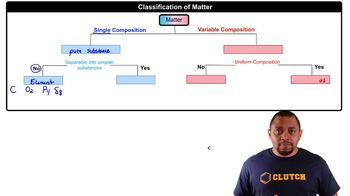
Law of Constant Composition

The Law of Constant Composition states that a chemical compound always contains its component elements in fixed ratio by mass, regardless of the sample size or source. This means that the proportion of each element in a compound remains constant, allowing for the determination of the composition of unknown samples based on known ratios.
Video consigliato:
Percorso guidato
04:19
Matter Composition

Molar Mass and Stoichiometry

Molar mass is the mass of one mole of a substance, typically expressed in grams per mole. In stoichiometry, the relationships between the quantities of reactants and products in a chemical reaction are analyzed. Understanding molar mass allows for the conversion between grams and moles, which is essential for calculating the amounts of elements in compounds.
Video consigliato:
Percorso guidato
02:11
Molar Mass Concept

Empirical Formula

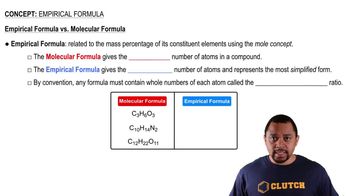
The empirical formula of a compound represents the simplest whole-number ratio of the elements present in that compound. By determining the mass of each element in a sample, one can calculate the empirical formula, which is crucial for understanding the composition of compounds like ascorbic acid and for comparing different samples.
Video consigliato:
Percorso guidato
02:26
Empirical vs Molecular Formula