
Ch.1 - Introduction: Matter, Energy, and Measurement
Brown - Chemistry: The Central Science 15th Edition
Brown15th EditionChemistry: The Central ScienceISBN: 9780137542970Non è quello che usi tu?Cambia libro di testo
Capitolo 1, Problema 24

A match is lit and held under a cold piece of metal. The following observations are made: (a) The match burns. (b) The metal gets warmer. (c) Water condenses on the metal. (d) Soot (carbon) is deposited on the metal. Which of these occurrences are due to physical changes, and which are due to chemical changes?

Guida verificata passo dopo passo
1
Identify the definition of physical and chemical changes: Physical changes involve changes in state or appearance without altering the substance's chemical composition, while chemical changes involve the formation of new substances with different chemical properties.
Analyze observation (a): The match burns. This involves combustion, a chemical reaction where the match reacts with oxygen to form new substances like carbon dioxide and water.
Analyze observation (b): The metal gets warmer. This is a physical change as it involves a change in temperature, not a change in the chemical composition of the metal.
Analyze observation (c): Water condenses on the metal. This is a physical change as it involves a change of state from gas to liquid, without altering the chemical composition of water.
Analyze observation (d): Soot (carbon) is deposited on the metal. This is a chemical change as it involves the formation of a new substance (carbon) from the incomplete combustion of the match.

Risposta video verificata per un problema simile:

Questa soluzione video è stata consigliata dai nostri tutor come utile per risolvere questo problema.
Durata del video:
2m

Concetti chiave

Ecco i concetti essenziali che devi comprendere per rispondere correttamente alla domanda.

Physical Changes

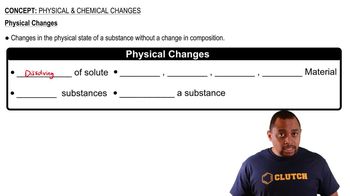
Physical changes are alterations that do not change the chemical composition of a substance. They involve changes in state, shape, or appearance, such as melting, freezing, or condensation. In the context of the question, the warming of the metal and the condensation of water are physical changes, as they do not involve a transformation of the substances involved.
Video consigliato:
Percorso guidato
01:41
Physical Changes

Chemical Changes

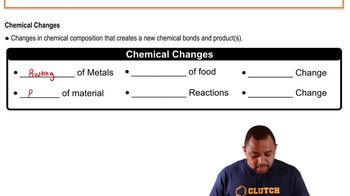
Chemical changes involve a transformation that alters the chemical composition of a substance, resulting in the formation of new substances. This can include reactions such as combustion, where reactants are converted into products with different properties. In the scenario presented, the burning of the match and the deposition of soot are chemical changes, as they indicate a reaction that produces new materials.
Video consigliato:
Percorso guidato
01:53
Chemical Changes

Energy Transfer

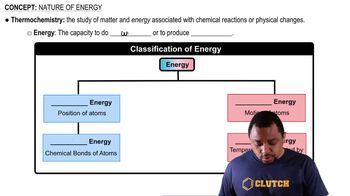
Energy transfer is a fundamental concept in chemistry that describes how energy moves from one system to another, often during physical or chemical changes. In this case, the heat from the burning match is transferred to the metal, causing it to warm up. This energy transfer is crucial for understanding the interactions between the match and the metal, as well as the resulting changes observed.
Video consigliato:
Percorso guidato
01:26
Nature of Energy